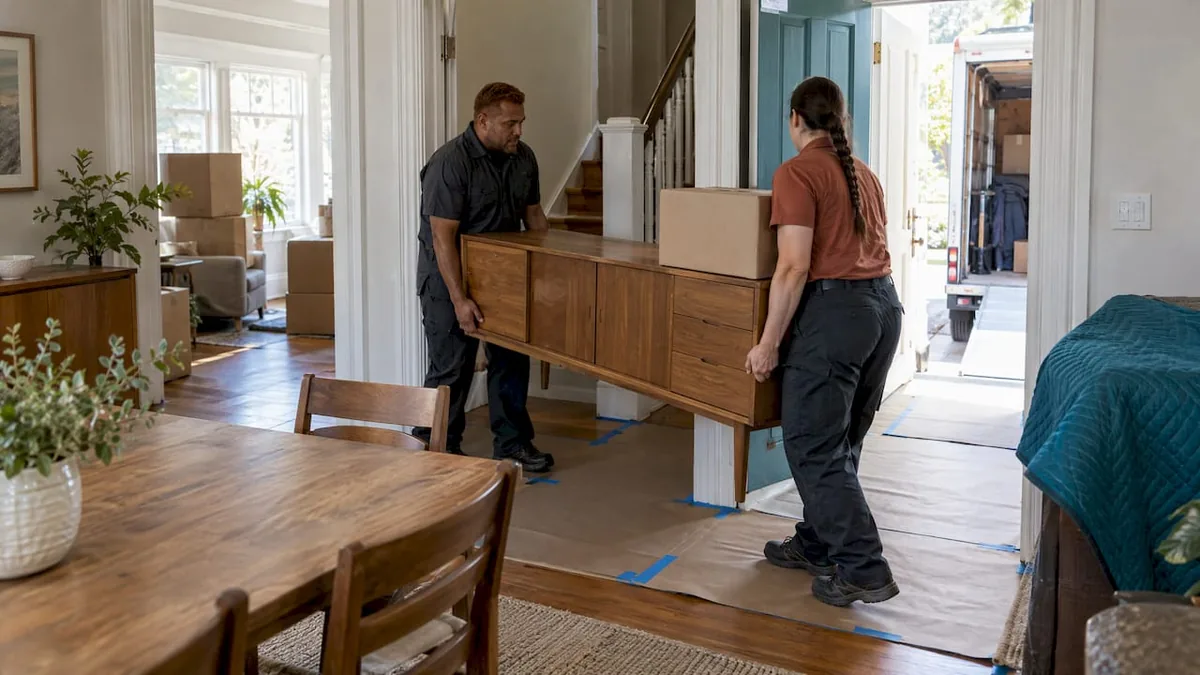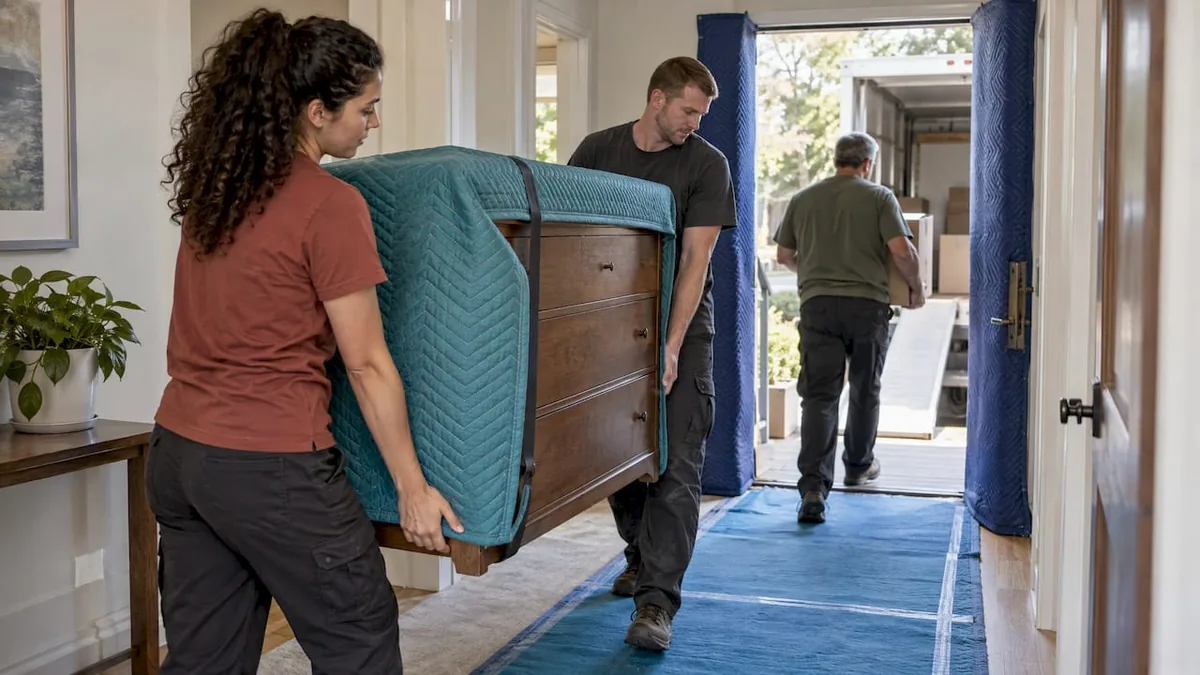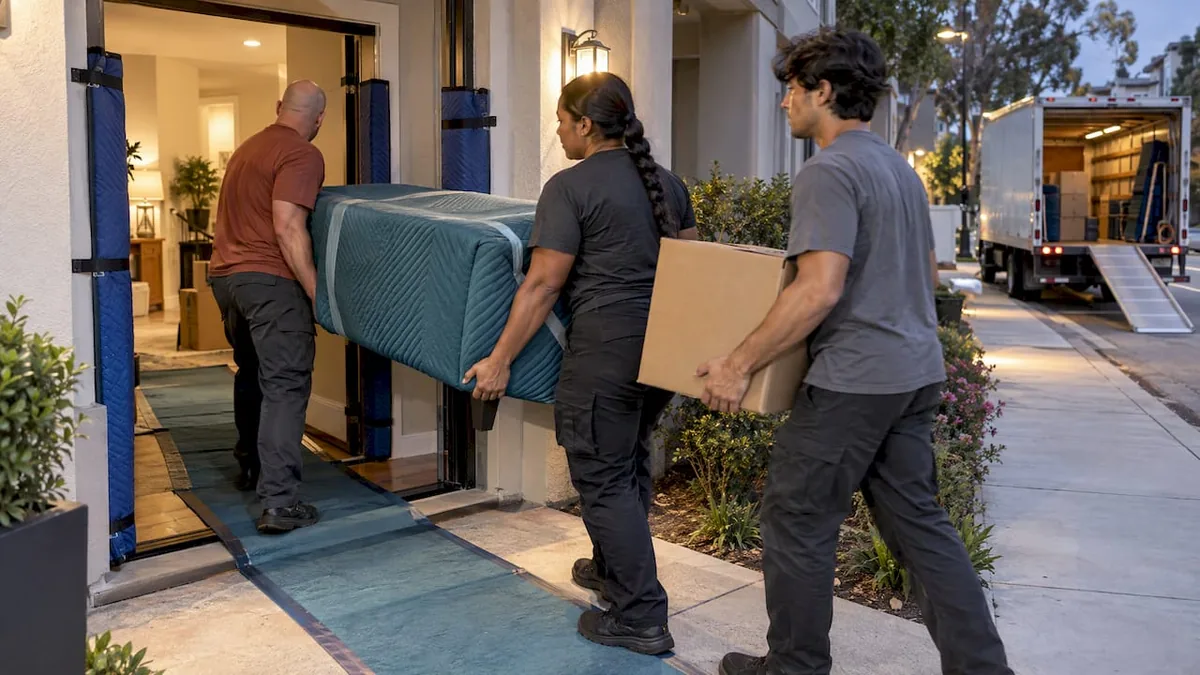
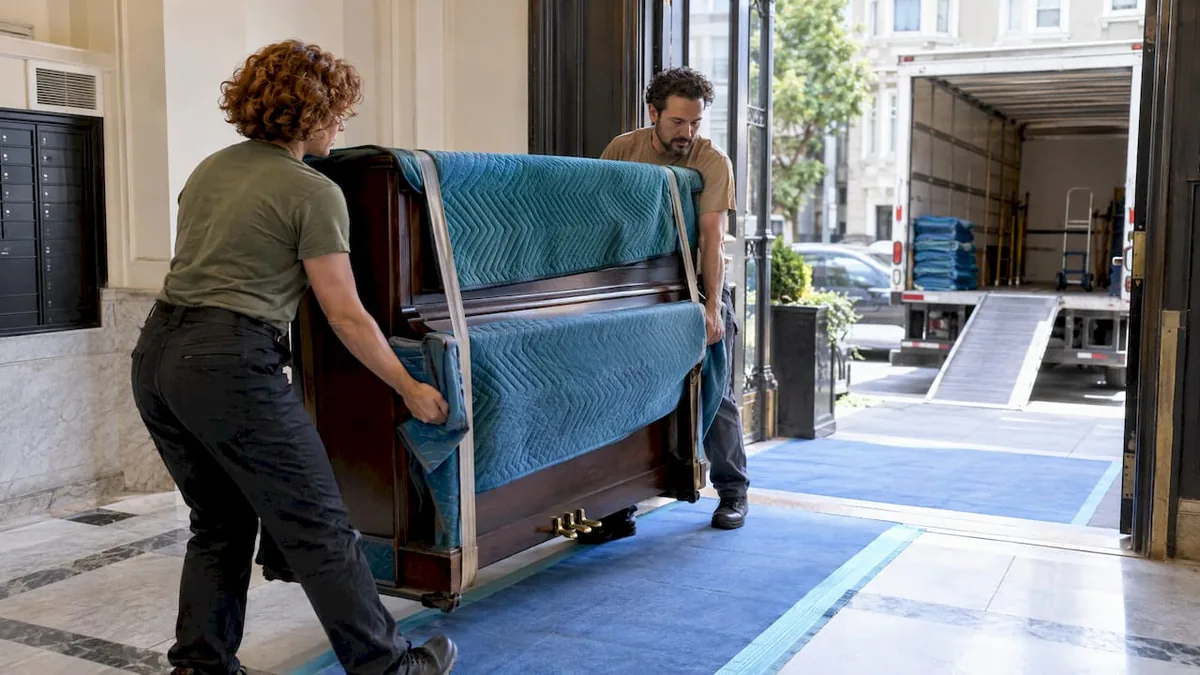
Heavy and oversized pieces, such as a piano, a safe, a sectional or a solid-wood dresser, are best moved by a licensed crew that plans the route before the truck arrives. In the Bay Area that planning matters more than muscle: narrow Victorian stairwells, elevator reservations in San Francisco condo towers, steep Peninsula driveways and tight Marin hillside entries decide how a heavy piece gets out and in. Impel Moving sends its own uniformed, trained employees on every move, with a documented scope and a written estimate, so the heavy pieces are planned for rather than discovered on move day.
Key Takeaways
- Heavy pieces are priced and handled by what stands between the item and the truck: stairs, elevators, long carries and doorways. Make sure each one is in the written estimate.
- Federal guidance says to get written estimates based on an in-person or virtual look at your belongings, and to confirm the mover’s authorization, insurance and U.S. DOT number.
- On interstate moves, Full Value Protection is the default unless you waive it in writing, and the waiver limits liability to 60 cents per pound per article.
- Impel Moving is licensed and insured under California permit Cal-T / MTR 0192323 and US DOT 3549568, and works San Francisco, the Peninsula, Silicon Valley and Marin every day.
Table of Contents
- What counts as a heavy or oversized item
- Why access decides the job in the Bay Area
- How to hire heavy item movers: the steps that protect you
- What affects the cost of moving a heavy item
- Preparing a heavy piece for the crew
- What to expect from a crew handling heavy furniture
- Damage coverage: what to understand before moving day
- Heavy items in an office or commercial move
- Our perspective on heavy item moving
- Plan your heavy move with Impel Moving
- FAQ
- Sources
What counts as a heavy or oversized item
There is no single weight at which an item becomes a specialty job. In practice, a piece needs a dedicated plan when one or more of these is true:
- It takes more than two people to carry safely, or it cannot be tilted or turned.
- It is long or deep enough that it will not clear a stairwell turn, elevator door or hallway without being angled or partly taken apart.
- It is fragile in relation to its weight, such as stone tabletops, glass-fronted cabinets or an upright piano with exposed casework.
- It has to travel a long way from the door to the truck, across a courtyard, down a hill or through a lobby.
Common examples in Bay Area homes include pianos, gun safes and fireproof safes, large sectional sofas, marble or stone tables, armoires, king-size bed frames, treadmills, and in offices, lateral file cabinets, conference tables and server racks. Each has its own risk. A piano can be damaged by a tilt that a dresser would shrug off, and a safe can damage floors and stair treads if it is dragged. We cover two of the most common in separate guides: how to move a piano safely, upright and grand, and moving a safe the right way.
Why access decides the job in the Bay Area
A 300-pound sofa on a ground floor with a driveway is a different job from the same sofa on the fourth floor of a walk-up. The weight did not change. The route did.
Here is what we plan around most often in each part of our service area:
- San Francisco: walk-up flats with steep, narrow stairs and tight landings, buildings that require elevator reservations, loading zones on busy or sloped streets, and condo towers with building rules about move times. Our San Francisco movers page covers local moving in the city.
- The Peninsula and Silicon Valley: larger homes with multiple floors, long driveways, backyard sheds, gym equipment, pianos and home offices full of heavy furniture.
- Marin: hillside homes, long stair runs from street to front door and winding access roads where the truck may park some distance from the entry.
- Offices and commercial spaces: freight elevators, loading docks, and equipment that has to arrive working, not just arrive.
Before a crew quotes a heavy piece, they need to know which of these applies. That is why a reliable estimate starts with a look at the space, not a phone guess.
How to hire heavy item movers: the steps that protect you
The Federal Motor Carrier Safety Administration (FMCSA) is the federal agency that oversees interstate movers. Its five steps for selecting a mover apply just as well to a single heavy piece as to a whole household. Here they are, with what to watch for at each one.
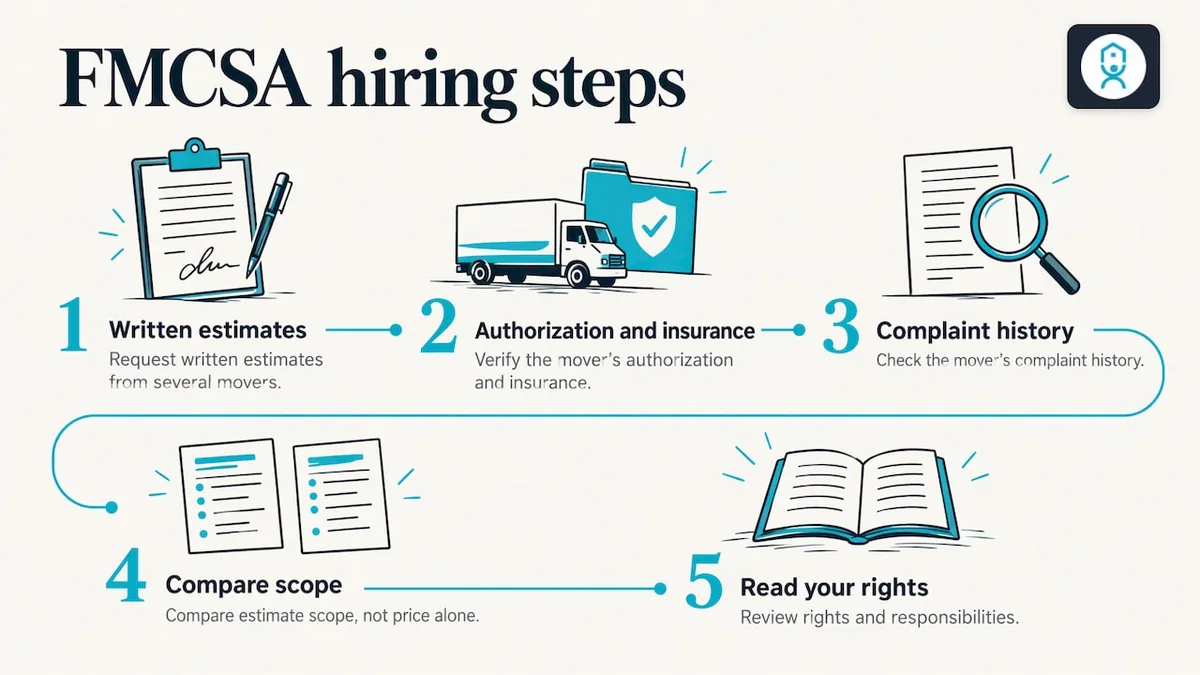
1. Get written estimates based on a real look at your items
FMCSA advises getting written estimates from several movers, based on in-person inspections. The American Moving & Storage Association likewise recommends estimates from at least three companies and warns against movers who quote by phone or online without ever seeing your belongings.
For heavy items this is where most surprises start. A quote that says “one piano, one sofa” without the stairs, the elevator and the carry distance leaves room for added charges later. Our approach is a documented scope and a written estimate, with no added charges on move day for work that should have been seen. Show the crew coordinator every heavy piece and every access point, including the ones that seem minor.
2. Verify authorization, insurance and the U.S. DOT number
A U.S. DOT number is the federal identification a mover uses for interstate operations. FMCSA tells consumers to confirm a mover’s authorization, insurance and DOT number. Impel Moving is licensed and insured under California permit Cal-T / MTR 0192323, and our long-distance moves run under US DOT 3549568.
3. Check complaint history
FMCSA’s search tool lets you look up a mover’s complaint history, and the agency also points to the Better Business Bureau and consumer protection agencies. Do this before you sign, not after.
4. Do not choose on the lowest price alone
FMCSA specifically cautions against picking solely on price. With heavy items, a low number often means the estimate left out the stairs, the long carry or the equipment needed. Compare what each estimate includes, not only the total.
5. Read your rights and responsibilities
FMCSA publishes a booklet called Your Rights and Responsibilities When You Move, which it points consumers to on the same page. It explains estimates, valuation and claims in plain terms, and it is worth reading before moving day.
What affects the cost of moving a heavy item
Final cost always comes from a written estimate, and we do not quote hourly rates. For general planning, the ranges we publish are on our Bay Area moving rates page. They are planning ranges, not quotes. Local moves with Impel have a three-hour minimum.
What moves a heavy-item estimate up or down is consistent across the industry. U.S. News lists these cost drivers:
- Whether the move is local, priced by crew and time, or long-distance, priced by distance and volume or weight.
- Added services such as packing.
- Special charges for stairs, elevators and long carries.
- Impracticable-operations fees for items like pianos, heavy safes and hot tubs.
- Season, with May through September the peak, and the day of the week.
The same source suggests comparing estimates that break down services, required fees, fuel surcharges and valuation coverage, with pickup and delivery locations, dates and estimated volume or weight. Use that as your checklist when you line up estimates. If you want a walkthrough of what each line means, our guide on how to read a moving quote goes through it.
Estimates and the 10 percent rule
FMCSA explains that movers must deliver your goods for no more than 10 percent above the price of a non-binding estimate, often called the 110 percent rule. A non-binding estimate is the mover’s best calculation of the cost, and the final bill depends on the actual weight or services. If you want a number that does not drift, read about what a binding moving estimate guarantees.
Preparing a heavy piece for the crew
Good preparation makes the walkthrough faster and the estimate more accurate. Before the crew arrives:
- Measure the item and the path. Record length, width, height and the narrowest point it must pass, whether a stair turn, a doorway or an elevator opening. Measure the destination too, not only the origin.
- Tell the coordinator everything about access. Number of stairs, landings, elevator reservation requirements, parking and loading restrictions, and the distance from the door to where the truck can stop.
- Empty the item. Remove contents from dressers, armoires, cabinets and safes. Loose contents shift and add weight.
- Say what the item is worth. Antiques, art and family pieces should be named at the estimate stage so they can be handled and documented appropriately. Our guide to moving art, antiques and valuables explains how that works in the Bay Area.
- Decide where it goes. Know exactly which room and wall the piece lands against so it is carried once, not repositioned repeatedly.
- Clear the route. Move rugs, plants, loose items and fragile decor away from the path.
Standing in the way is also a safety matter: keep children and pets out of the route while a heavy piece is moving.
What to expect from a crew handling heavy furniture
Heavy furniture moves go well when the crew has the right people, equipment and sequence. Our crews are Impel’s own uniformed, trained employees, never subcontractors or day labor, and each move has one coordinator from quote to placement, so the person who saw the stairwell is the person who knows the plan.
On standard residential moves, furniture protection is included, along with disassembly and reassembly of furniture as part of the booked move. That matters for bed frames, large wardrobes and tables that will not clear a doorway whole. Taking a piece apart is often the safest way to get it through a tight Bay Area entry, and putting it back together at the new place means you are not left with a pile of parts. Furniture assembly and disassembly is available only as part of a booked moving service. You can see how we handle protection on our careful handling page.

For pieces that need extra attention, such as high-value furniture, we offer white glove service. And if a heavy piece is not coming with you, furniture disposal can be part of the same move, so an old sleeper sofa or oversized desk does not become a separate errand.
Damage coverage: what to understand before moving day
Coverage works differently from what most people expect, and heavy items are where it matters most. For interstate moves, federal rules require the written estimate to be dated and signed by both parties and based on a physical or virtual survey. Federal regulation 49 CFR Part 375, Appendix A also sets out the two basic levels of liability:
| Coverage level | What it means | Cost to you |
|---|---|---|
| Full Value Protection | The default unless you waive it in writing. Minimum valuation is $6 per pound times the shipment weight. | Priced into the move |
| Released Value | Limits the mover’s liability to 60 cents per pound per article. | No charge |
The 60-cent figure is why weight matters. Under Released Value, a 100-pound piece is limited to $60 of liability, regardless of what it is worth. If you are moving a piece with real value, read the coverage section of the estimate closely and choose deliberately.
The same regulation gives you nine months from delivery to file a written claim for loss or damage, which the mover must acknowledge within 30 days and dispose of within 120 days. To understand how liability for damaged or lost items is handled in other places, you can also read about liability for items damaged in a move.
These federal rules govern interstate moves. For a long-distance move out of California, our long-distance moving page explains how we handle it under US DOT 3549568.
Heavy items in an office or commercial move
Businesses move heavy things too: safes, lateral files, reception desks, conference tables, kitchen equipment and server racks. The difference is downtime. A medical practice, restaurant or retail store has to reopen on schedule, so the plan has to cover sequence and placement, not just transport.
We handle office relocation, medical and dental office moves, retail store relocation, restaurant moves, warehouse and industrial moves and IT and server relocation. For each, the same rule applies: put every heavy or oversized piece on the written scope early.
Our perspective on heavy item moving
Heavy items are rarely the real problem. The access is. A piece that looks impossible on the stairs often moves safely once someone has measured the turn, decided what comes apart and planned who carries what.
That is why we think the estimate is where a heavy move is won or lost. We build ours from a documented scope, so the stairs, the elevator and the long carry are written down before move day. One coordinator stays with you from quote to placement, and the crew that arrives is Impel’s own, in uniform and trained, working San Francisco, the Peninsula, Silicon Valley and Marin every day.
Furniture protection and disassembly and reassembly are part of our standard residential moves for the same reason: the safest way through a tight Bay Area doorway is often a planned one. We would rather you tell us about the heavy piano and the narrow stairwell at the start than have either be a surprise.
Julia
Plan your heavy move with Impel Moving
If you have a piano, safe, sectional, armoire or an office full of heavy equipment, the next step is a written estimate based on a documented scope. Tell us about every heavy piece and how it gets in and out, and your coordinator will build the plan around it. Our residential movers handle homes and our apartment movers handle stairs, elevators and tight access in buildings across the city.

Get a free written moving estimate from Impel Moving and list your heaviest pieces first.
FAQ
Do movers charge extra for heavy or oversized items?
Often, yes, though how depends on the move. Industry pricing commonly includes special charges for stairs, elevators and long carries, and impracticable-operations fees for items like pianos and heavy safes, according to U.S. News. With Impel Moving, these items go on the documented scope, and the final cost comes from the written estimate.
How do I find help to move heavy furniture?
Start with a licensed, insured mover that will look at your items before quoting. FMCSA advises verifying authorization, insurance and the U.S. DOT number, and checking complaint history before you hire. In the Bay Area, you can request a free written estimate from Impel Moving, whose permit and DOT numbers are listed above.
How long do I have to report damage to a heavy item?
For interstate moves, federal rules give you nine months from delivery to file a written claim for loss or damage. The mover must acknowledge it within 30 days and dispose of it within 120 days, per 49 CFR Part 375. Note any visible damage at delivery and keep photos.
Can a heavy item be taken apart for the move?
Many pieces can, and it is often the safest way through tight access. On standard residential moves with Impel Moving, furniture disassembly and reassembly is included. It is offered only as part of a booked moving service.
Sources
- Steps to Select a Mover | FMCSA
- Prepare & Choose a Mover | American Moving & Storage Association
- Compare Moving Quotes Online | U.S. News Real Estate
- 49 CFR Part 375, Appendix A | eCFR
- Liability for items damaged in a move