An evening move is a normal move that starts late in the day or runs after 5 p.m., and in the Bay Area it is often the practical choice: offices empty out, apartment buildings free up their elevators, and families avoid taking a day off work. What makes it succeed is not the hour but the paperwork and planning around it: a written estimate that states the time window, building access settled in advance, and a crew that is licensed, insured and employed by the mover. At Impel Moving, our own uniformed, trained crews work San Francisco, the Peninsula, Silicon Valley and Marin every day, and you can request a free written moving estimate that documents the scope of your move before anything is scheduled.
Key Takeaways
- Evening, after-hours and night moves are the same service: the work simply starts or continues after the regular business day, so the time window belongs in your written estimate.
- Offices, medical practices, retailers and restaurants gain the most from after-hours moves because the move does not interrupt business hours.
- The checks that matter most after dark are building access, parking, lighting at both addresses and who is on the crew.
- Price depends on scope and time, so compare written estimates for the same inventory and the same hours rather than a single headline number.
- A good evening move is decided the week before: packing finished, paths cleared, elevator and loading dock reserved.
Table of Contents
- What people mean by evening, after-hours and night movers
- Who benefits most from a move after hours
- The honest trade-offs of moving after dark
- What to confirm before you book an evening move
- How after-hours moves are priced
- How to prepare for a move after dark
- Evening move or daytime move: how to choose
- Impel Moving for after-hours and evening moves
- Our perspective on late-day moves
- FAQ
- Sources
What people mean by evening, after-hours and night movers
The three phrases describe different points on the same clock. “Evening movers” usually means a move that starts in the late afternoon and finishes after dark. “After-hours movers” is the term businesses use for moves that happen outside their operating hours, which may be evenings, overnight or a weekend. “Night moving” means the bulk of the loading and unloading happens overnight.
What they share is a purpose. Someone needs the move to happen while a space is empty, while a building allows it, or while the rest of life is paused. Because the schedule is the whole point, treat the start time, the expected finish time and the latest hour the crew can work as terms you want written down, not assumptions.
The common questions are fair ones. Do movers work after 5 p.m.? It depends on the company and on the building you are moving into or out of. Some companies treat late work as a standard option, and some schedule it only on request, so ask at the estimate stage. Moving companies also vary in how they price late hours, which is another reason to get the details in writing.
Who benefits most from a move after hours
Offices, clinics and retail
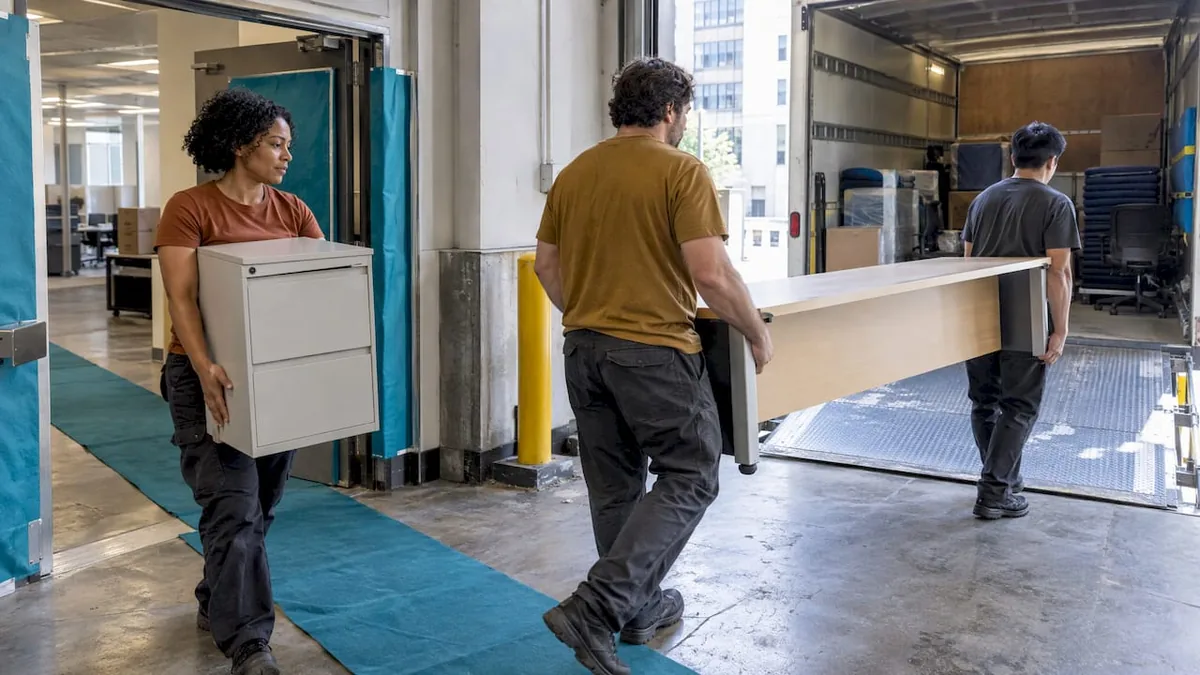
For a business, a day of downtime costs more than the move itself. Moving after closing means desks, files and equipment travel while nobody is trying to use them, and the new space can be ready by morning. Our office relocation and commercial moving services cover this kind of project, and corporate relocation fits teams moving as a group.
Some businesses have specific needs after hours:
- Medical and dental offices: equipment and records have to be relocated between the last appointment and the first one at the new site. See our medical and dental office movers page.
- Retail stores: fixtures and stock can move once the doors are locked, which shortens the dark period before reopening. See retail store relocation.
- Restaurants and hospitality: kitchens and dining rooms are busiest in the evening, so the realistic window is often after service ends. See restaurant movers and hotel and hospitality relocation.
- IT and server rooms: systems are usually taken offline when traffic is lowest, which is often late. See IT and server relocation.
- Warehouses: loading docks are easier to work when the daytime shipping schedule is over. See warehouse and industrial movers.
Apartment and condo residents in San Francisco
San Francisco buildings often limit when a move can happen. Many have a freight elevator or loading area that must be reserved, and building managers commonly set the hours. Evening slots can be the ones that are available, or the ones that keep you from blocking the lobby when neighbors are coming and going. Our apartment movers handle the building side of the move as part of the plan, and your first step is to ask your property manager what the move-in and move-out hours are.
Families and homeowners on the Peninsula, in Silicon Valley and in Marin
If both adults work, or children are in school until mid-afternoon, a late-day start lets a family keep the working day. It also means the house is calm while the crew works. Our residential movers and large home movers serve homes from Marin down through the Peninsula and Silicon Valley, including Los Altos.
The honest trade-offs of moving after dark
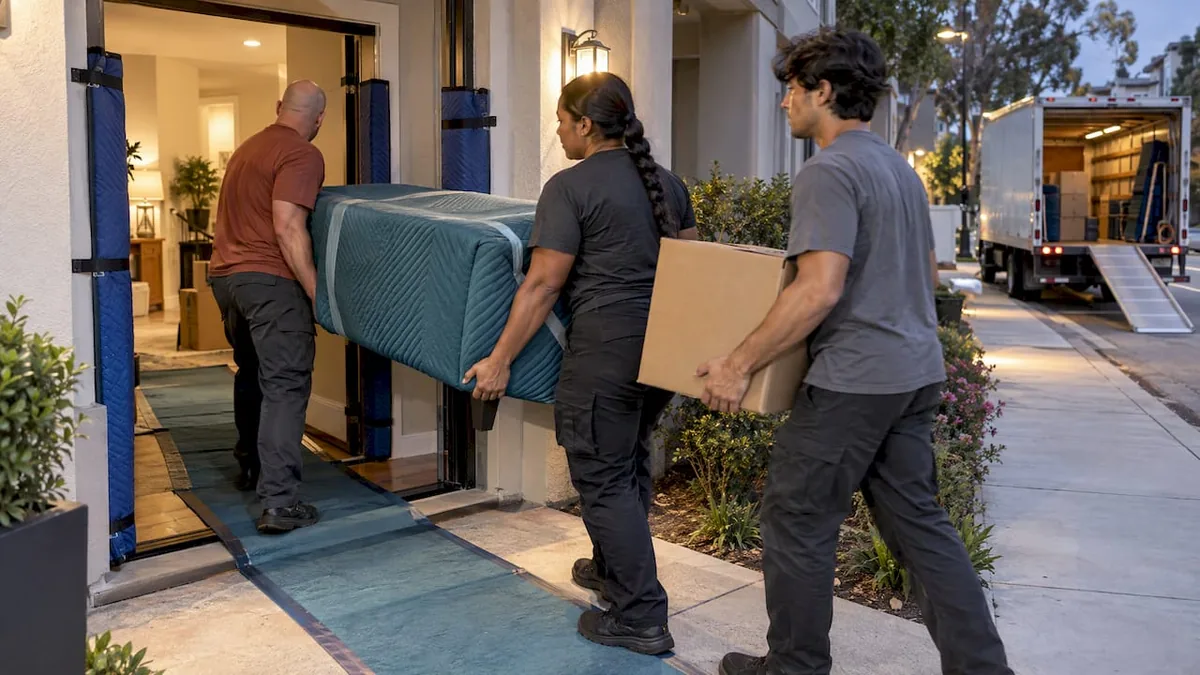
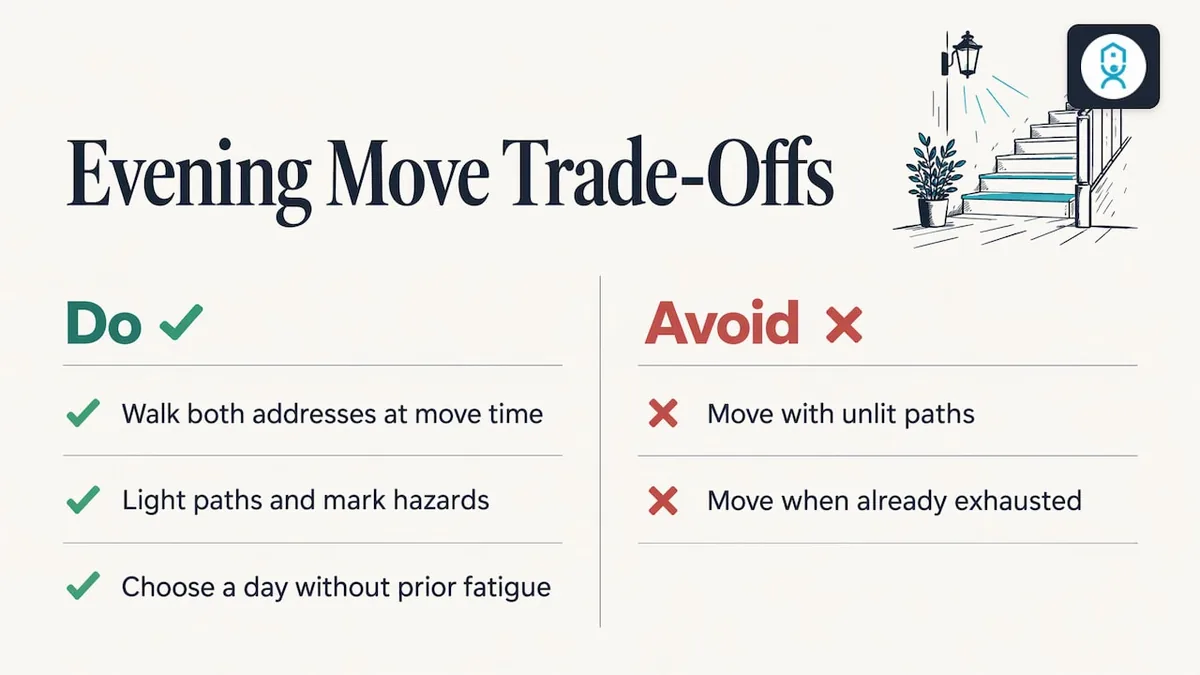
An evening move is a good solution when you plan for what changes after sunset. Light is the obvious one: driveways, stairwells, back lanes and loading docks look different at 8 p.m. than at noon. Fatigue is another: a crew finishing a long day needs a good plan, supervision and clear communication. Neighbors matter too, because stairs, hallways and shared walls carry sound at night.
The fix for each is preparation. Walk both addresses at the time of day the move will happen, and look at what the lighting is actually like. Make sure paths are lit, steps are visible and any hazards are marked. The same logic applies to your own preparation: if you are doing a late move, choose a day when you are not already exhausted. For practical advice on reducing safety risks during a move, the principle is the same everywhere: clear paths, sturdy containers and a plan for every room.
This is also where crew quality matters. Impel Moving uses its own uniformed, trained employees, never day labor, so the people who walk your estimate with you are part of the same company that does the work.
What to confirm before you book an evening move
Use this checklist when you request an estimate. Each item should end up in writing.
- The time window. The earliest arrival, the expected finish and the latest the crew can work.
- Building rules. Move-in and move-out hours, elevator reservations, loading dock access and whether the building requires proof of insurance.
- Parking. Where the moving truck will stop, how close it is to the door and whether the street has restrictions in the evening. Many Bay Area streets have posted rules, so check the signs and with your city or building about reserved curb space.
- Lighting. Is there light at the curb, the entry, the stairs and inside the new space? Make sure someone can switch on the utilities at the destination before you arrive.
- Quiet hours. Your lease, HOA or building may set limits on noise. Ask what they are and share them with your mover.
- Who is on the crew. Confirm the people are the mover’s own employees, not temporary labor.
- License and insurance. Local moves in California require a state permit, and long-distance moves require a U.S. DOT number. Impel Moving is licensed and insured under California permit Cal-T / MTR 0192323, with long-distance moves under US DOT 3549568.
- The scope. Which rooms, which furniture, whether items need disassembly, and what the crew is packing.
The American Trucking Associations’ moving arm advises getting in-home, written, signed estimates from at least three companies and signing an order for service that includes the agreed-on price. That applies to evening moves just as it does to daytime ones, and it is especially useful here because the schedule is part of what you are buying.
How after-hours moves are priced
Movers price a local move on the scope of the job and the time it takes, and an evening start can change the schedule even when the work does not. We do not publish an hourly figure, and a number you see elsewhere is only useful if it describes the same inventory, the same building access and the same hours as yours.
What moves the final cost:
- The size of the move: the number of rooms, the amount of furniture and the number of boxes.
- Access: stairs, long carries, elevator waits and parking distance.
- Services: packing, unpacking, furniture protection, disposal and white glove handling.
- Time: how long the work takes, including any late finish.
- Distance: a local move and a long-distance move are priced differently.
For local moves, Impel Moving has a three-hour minimum. Our planning ranges are published on the Bay Area moving costs page, and they are planning ranges, not quotes: the final cost comes from a written estimate based on a documented scope. If you want to understand what each line in an estimate means, our guide on how to read a moving quote walks through it.
Our estimate is built on a documented scope, so the written estimate does not add charges on move day for work that should have been seen. That is the point of walking the scope in advance, including the stairs, the parking and the hours.
How to prepare for a move after dark
Evening moves leave less slack at the end of the day, so the work before it counts more.
Pack early and label by room. A crew can only move quickly in poor light if boxes are closed, labeled and stacked in one place. If you are behind, our guide on what to do when movers arrive tomorrow and you are not packed gives you a plan, and our packing tips cover the basics. Our packing service and unpacking service take both ends of that off your hands.
Clear the paths. Move rugs, cords and loose items out of hallways and off stairs. Open every door the crew will use and prop it safely.
Light the route. Turn on porch, stair and hallway lights at both addresses. At a new home, check that bulbs work before moving day.
Reserve what the building controls. Book the elevator, the loading dock and any parking space as soon as the date is set.
Keep essentials with you. Medications, documents, chargers, keys and a change of clothes should travel in your car, not on the truck.
Tell neighbors. A short note about the time of the move helps with shared walls and shared entrances.
Plan the first night. Know which room will be set up first, usually the bedroom, so beds are assembled and ready when the crew leaves. For Impel Moving, standard residential moves include furniture protection plus furniture disassembly and reassembly as part of the booked move.
Evening move or daytime move: how to choose
| If this describes you | Evening or after-hours move | Daytime move |
|---|---|---|
| Business that cannot close during the day | Fits well: moves happen once you are closed | Interrupts operations |
| Apartment with limited elevator hours | May fit if the building allows it | Often easier to reserve |
| Family with school and work schedules | Keeps the workday intact | May need time off |
| Move that needs good daylight outdoors | Plan lighting carefully | Natural light helps |
| Tight lease handover | Can add hours to the same day | Fewer hours available |
If you are still deciding on timing in general, our guide to the best time to move in San Francisco covers seasons and days of the week. If your date is close, our article on same day moving explains how to book a mover quickly.
Impel Moving for after-hours and evening moves
When you plan a late move, the details are what protect you: a documented scope, a written estimate, a single contact and a crew you can identify. Impel Moving is locally owned and operated in the San Francisco Bay Area, not a franchise or a broker. Every move gets one coordinator from quote to placement, and our crews are our own uniformed, trained employees.
Tell us the window you need when you request your free written moving estimate, and we will document the scope for your home, apartment or workplace. Start with our full moving service page, or go straight to the free moving estimate.

For items that need extra care, see how we protect your belongings and our white glove delivery. If you have furniture you no longer want to bring along, we also offer furniture disposal with a booked move.
Our perspective on late-day moves
Timing is a planning decision, and we treat it the way we treat everything else about a move: it should be written down. When a customer asks about an evening start, the useful conversation is about the scope, the building and the hours, not the clock alone.
We believe the strongest protection a customer has is a written estimate based on a documented scope. It means the stairs, the elevator, the parking and the finish time are discussed before moving day instead of on it. It is also why we assign one coordinator from quote to placement: one person who knows your plan.
The people matter as much as the plan. Our crews are Impel’s own uniformed, trained employees. When light is low and the day is long, a crew that works together, under one company’s supervision, is what keeps furniture protected and the move on schedule.
Choose a licensed and insured mover, check the permit and DOT numbers, and get the estimate in writing. That advice holds for any hour of the day.
Julia
FAQ
Do movers work after 5 p.m.?
Many do, but it depends on the company and on the building. Ask when you request your estimate, and have the start time and expected finish written into it. Check the building’s move hours as well, because they may be stricter than the mover’s.
Is an evening move cheaper or more expensive?
It depends on the scope, the access and the time the work takes, so compare written estimates for the same inventory and hours. For local moves with Impel Moving there is a three-hour minimum, and our planning ranges are on the moving costs page. The final cost comes from a written estimate.
Can an office or clinic move after hours?
Yes, and it is one of the most common reasons to schedule late. The goal is to move equipment, files and furniture after closing so the new space can open on time. Request a free written estimate and describe your operating hours so the scope reflects them.
How should I prepare for a move at night?
Pack and label early, clear paths, light every route at both addresses and reserve the elevator, loading area and parking in advance. Keep medications, documents and keys with you. Confirm the building’s quiet hours and share them with the mover.