A binding moving estimate is a written agreement that fixes the price of your move based on the items and services listed on it. For an interstate move, FMCSA says you cannot be required to pay more than the estimated amount at delivery, unless you add items or services. For a move that stays inside California, the rules come from the state instead, and the protection that matters most is a written estimate built on a real inspection of your belongings. At Impel Moving, every move starts with a documented scope and a written estimate, and you can request a free written moving estimate to see how that looks for your home or office.
TL;DR
- A binding estimate guarantees the total price for the quantities and services written on it. Anything added later needs a new or amended document.
- Federal binding-estimate rules cover interstate household moves. In-state California moves follow the Bureau of Household Goods and Services (BHGS) tariff, which requires a written, inspection-based estimate and signed change orders.
- A nonbinding estimate is not a guarantee. On an interstate move, the mover cannot require more than 110% of it at delivery to release your goods.
- The estimate is only as accurate as the details behind it: stairs, elevators, long carries, parking and special items.
- Read the scope line by line before you sign, and make sure you get a dated copy.
Table of Contents
- What a binding estimate actually guarantees
- Binding vs. nonbinding: the difference in plain terms
- Which rules apply to your move: interstate or in-state
- What a solid estimate should contain
- The Bay Area details that change a moving estimate
- What happens if you add items or services
- If the mover asks for more than the estimate at delivery
- How to compare two estimates fairly
- How Impel Moving writes an estimate
- Ready for a written estimate?
- Our perspective
- FAQ
- Sources
What a binding estimate actually guarantees
The federal rule defines a binding estimate as an advance agreement that guarantees the total cost based on the quantities and services listed. Under 49 CFR 375.401, the document must show that you and the mover are bound by the charges, both of you must sign it, and the mover must give you a dated copy when you sign.
The word that matters is “listed.” A binding estimate protects the price of what is written on it. It does not freeze the price of a move that turns out to be bigger or more complicated than what was written. If you add furniture, request packing you did not book, or conditions at the address change the job, the original number no longer describes the work.
That is why a good estimate begins with a detailed inventory and a clear description of the services. A vague line such as “2-bedroom apartment” leaves room for disagreement. A line that names the rooms, the large furniture, the packing, the assembly work and the access at both addresses leaves very little.
Binding vs. nonbinding: the difference in plain terms
A nonbinding estimate is the mover’s best calculation, not a promise. According to FMCSA, the final charges on a nonbinding interstate estimate are based on actual shipment weight, the services performed and the mover’s published tariff (its official price list).
| Binding estimate | Nonbinding estimate | |
|---|---|---|
| What it is | Fixed price for listed items and services | Best calculation of likely cost |
| Final charge | Based on what is listed | Based on actual weight, services and tariff |
| Protection at delivery | You do not pay more than the estimate for the listed work | Mover cannot require more than 110% of the estimate to release the shipment |
| If the job grows | New binding estimate, or written change | Charges reflect the added weight or services |
The 110% figure comes from 49 CFR 375.407. It applies to interstate collect-on-delivery moves with a nonbinding estimate: the mover must release your shipment once you pay up to 110% of the estimate plus certain qualifying charges. It is a delivery-day protection, not a promise that the final lawful bill can never be higher, so a nonbinding number should be read as a range, not a price.
Which rules apply to your move: interstate or in-state
This is where Bay Area movers get confusing questions, because many people searching this term are moving within California.
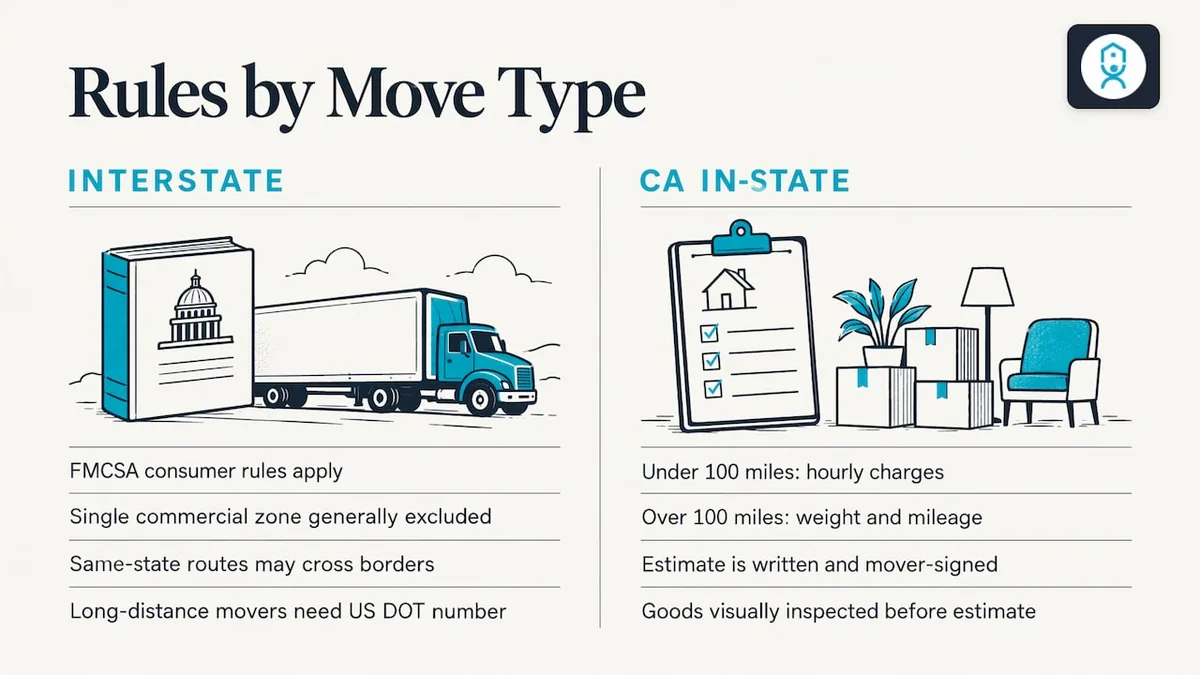
Interstate moves. FMCSA’s consumer rules apply to movers transporting household goods by motor vehicle in interstate commerce, and generally do not apply to a move within a single commercial zone. FMCSA also counts moves between states, moves between a state and another country, and same-state moves whose route passes through another state or outside the country. A move from San Francisco to Seattle is the clear case. A long-distance mover must carry a US DOT number, which is how you look up its federal record.
In-state California moves. The state regulator, BHGS, sets the rules. Its consumer guide says that for intrastate moves the mover signs the estimate, that moves under 100 miles may be charged by the hour, and that moves over 100 miles must be charged by weight and mileage. The 2026 Maximum Rates and Rules tariff (Item 108) requires movers to visually inspect your goods before giving an estimate, and the estimate must be in writing.
So for a typical San Francisco, Peninsula, Silicon Valley or Marin move, the federal phrase “binding estimate” is not the whole story. What protects you is the combination of an inspected, written estimate, a signed copy in your hands, and a signed change order for anything added. Ask the mover to explain, in writing, which kind of price document they are giving you and which rules govern it.
What a solid estimate should contain
Whether the move is local or long-distance, check for these items before you sign.
- Both addresses and a clear description of the work. Origin, destination, and the services included, such as packing, unpacking, furniture assembly and disassembly, or disposal.
- A real inventory. For interstate moves, FMCSA says the mover must provide a written estimate of all charges, including transportation, accessorial and advance charges, based on an actual or virtual inspection.
- Access conditions. The BHGS tariff says an estimate should consider origin factors including flights of stairs, long carries, elevators, and hoisting or lowering.
- Signatures and a duplicate. The California tariff requires the mover’s estimator to sign and give you a duplicate. The federal rule requires both parties to sign and a dated copy for you.
- A statement of how added work is handled. You should know, before moving day, what happens if you add a room’s worth of boxes.
The Bay Area details that change a moving estimate
Accessorial charges are the extras that depend on the address rather than the volume: stairs, elevators, long carries, and similar access issues. Under 49 CFR 375.401, these must be determined before the bill of lading (the contract and receipt for your goods) is prepared. If the mover failed to determine them beforehand, it must deliver the goods and bill those additional charges after 30 days.
That rule matters in the Bay Area because the region is full of access challenges that an inspection should catch:
- San Francisco flats and Victorians. Walk-up buildings with several flights, narrow stairwells and no street loading zone.
- High-rise condos and apartments. Freight elevator reservations, building move-in windows and certificate-of-insurance requirements.
- Hillside homes on the Peninsula and in Marin. Steep driveways, long carries from where a truck can legally park, and tight turns.
- Silicon Valley single-family homes. Large inventories, garages and storage, plus extra rooms that people forget to count.
- Office, medical and retail moves. Server rooms, specialty equipment, after-hours building access and phased moves.
The most useful thing you can do is tell the estimator about every one of these, even if they seem minor. An estimate that overlooks a three-flight walk-up is the one that gets revised on moving day.
What happens if you add items or services
Changes are normal. People find a storage closet, decide to have the movers pack the kitchen, or buy a sofa between the estimate and the move. What matters is that the change is documented before loading.
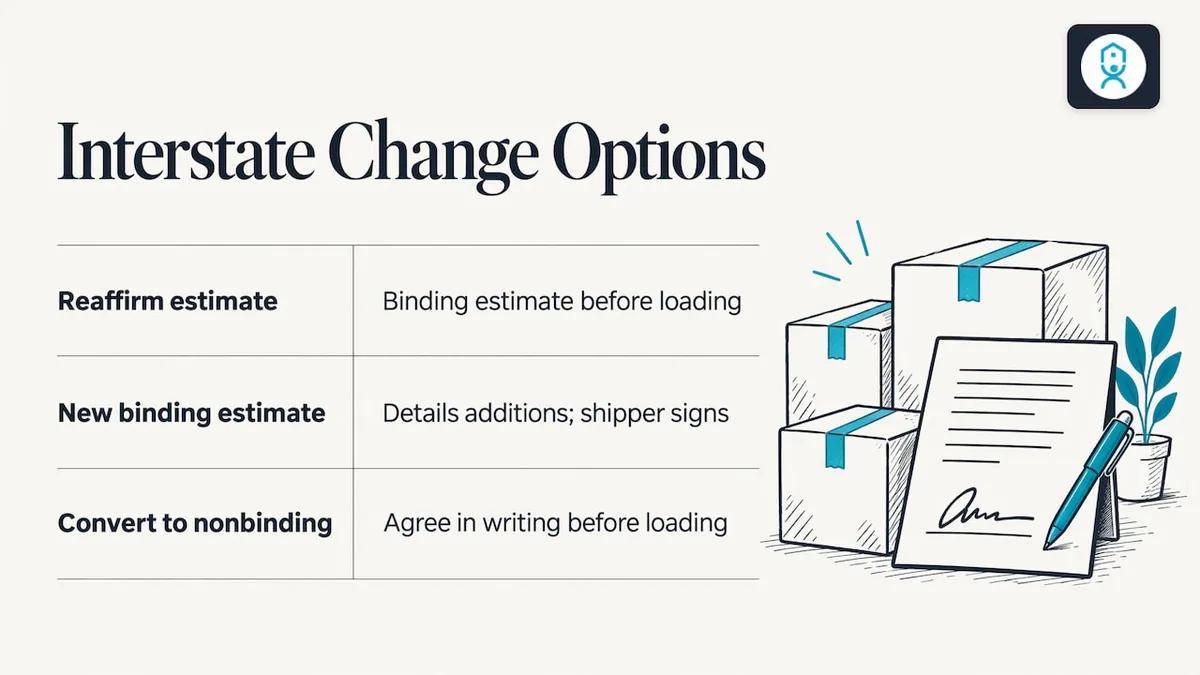
For interstate moves, the November 2023 FMCSA technical corrections (effective November 17, 2023) say that when a shipment has added goods or services, the mover must do one of three things before loading: reaffirm the binding estimate, issue a detailed new binding estimate signed by the shipper, or agree in writing to convert it to nonbinding. The same corrections restored wording that a replacement estimate must detail the added goods or services.
For in-state moves, BHGS’s consumer guide says that adding items after the inspection requires a signed change order for an in-state move, or an updated estimate for a move into or out of California, before loading. The 2026 tariff adds that additional articles or services not in the estimate require a change order signed by the mover and shipper before the added service begins.
In practice: if a mover wants to charge for something that is not on your paperwork, the first question is where the signed change order is. Do not agree to extra work verbally at the curb.

If the mover asks for more than the estimate at delivery
Stay calm and go to the paperwork.
- Find the estimate and any signed changes. Compare the charge to the listed items and services.
- Ask which line item the extra charge belongs to. On an interstate binding estimate, you cannot be required to pay more than the estimate for the listed items and services. Added items or unforeseen circumstances require a new binding estimate.
- Check whether a change was documented before loading. If it was not, the original estimate stands under the federal rule.
- Keep copies and take photos. Keep your signed estimate, bill of lading and any inventory.
- Escalate through the right authority. For an in-state California move, that is BHGS. For an interstate move, that is FMCSA.
Our guide to verifying a licensed interstate mover shows how to look up a mover’s federal registration before you book, which prevents most of these situations.
How to compare two estimates fairly
Two numbers are rarely comparable until you line up the scope. Put the documents side by side and check:
- The same inventory, room by room.
- The same services: packing, furniture protection, assembly and disassembly, disposal.
- The same access assumptions at both addresses.
- The same pricing method. An hourly estimate under 100 miles in California is a different animal from a weight-and-mileage price over 100 miles.
- Whether the mover is licensed. In California, look for the state household mover permit, and for long-distance work, a US DOT number. Our article on how to check that a San Francisco mover is licensed walks through it.
The lowest number with the thinnest description is usually the one that changes. A written scope with more detail is easier to hold a mover to.
How Impel Moving writes an estimate
Impel Moving is a locally owned and operated moving company in the San Francisco Bay Area, not a franchise or a broker. Every move gets a documented scope, a written estimate and one coordinator from quote to placement. The estimate is based on that documented scope, with no added charges on move day for work that should have been seen. Your move is done by Impel’s own uniformed, trained employees. We are licensed and insured under California permit Cal-T / MTR 0192323, and our long-distance moves operate under US DOT 3549568.
Here is how that connects to each part of the process above:
- The walkthrough. The documented scope is where stairs, elevators, long carries and parking get written down, so they are part of the estimate instead of a surprise.
- Standard residential moves. They include furniture protection plus furniture disassembly and reassembly, so those items are part of the scope you read.
- Local moves. Local moves with Impel have a three-hour minimum.
- Costs. For budgeting before an estimate, see the planning ranges on our rates page. They are planning ranges, not quotes, and the final cost comes from a written estimate.
Ready for a written estimate?
We handle residential and apartment moves across San Francisco, the Peninsula, Silicon Valley and Marin, along with long-distance moves and office, medical, retail and other commercial relocations. If you want to see a documented scope for your own address, ask for a free written moving estimate.
We pair the estimate with one coordinator, so the person who documented your scope is the person you talk to through placement. You can start from our moving costs page.
Our perspective
Most estimate disputes we hear about in the moving industry come from one gap: the paper describes a smaller job than the one on moving day. Closing that gap is the whole point of a binding or written estimate, and it happens before anyone loads a box.
That is why we start with a documented scope. We want the stairs, the elevator, the carry from the curb, the packing and the furniture assembly written down while there is still time to price them properly. It is also why one coordinator stays with your move from quote to placement. When something changes, there is one person who knows what the paper says.
We would rather you read the estimate closely than trust us blindly. Ask what is included, ask how a change is documented, and look at who will be doing the work. Our crews are Impel’s own uniformed, trained employees, and our licensing is Cal-T / MTR 0192323 and US DOT 3549568.
A clear estimate is not a sales document. It is the agreement that lets a move go the way both sides expected.
Julia
FAQ
Is a binding estimate the same as a guaranteed price?
It is a guaranteed price for the items and services listed on it. Under the federal rule, you do not pay more than the estimated amount at delivery for that listed work. If you add items or services, a new or amended estimate is needed.
Do binding estimates apply to local moves within California?
The federal binding-estimate rules cover interstate household moves, and FMCSA says they generally do not apply to a move within a single commercial zone. For in-state moves, California’s BHGS tariff requires a written estimate based on a visual inspection and a signed change order for added work. Ask your mover to explain which pricing method they use.
Can a mover charge more than a nonbinding estimate?
Yes, because final charges follow actual weight, services and the tariff. On an interstate collect-on-delivery move, the mover must release your shipment once you pay up to 110% of the estimate, plus certain qualifying charges. Further billing may follow.
What should I do if my belongings change after the estimate?
Tell your mover as early as you can, and before loading day. The mover should issue a signed change order for an in-state move or an updated estimate for a move into or out of California, according to BHGS. Do not agree to extra work without it in writing.
How do I get an estimate from Impel Moving?
Request a free written moving estimate. Your estimate is based on a documented scope, and one coordinator stays with you from quote to placement. For budgeting before you book, our planning ranges give a starting point, while the final cost comes from the written estimate.
Sources
- What is a binding move estimate? | FMCSA
- 49 CFR 375.401, Must I estimate charges? | eCFR
- 49 CFR 375.407, Under what circumstances must I release a shipment? | eCFR
- General Requirements (Subpart A) | FMCSA
- Frequently Asked Questions | FMCSA
- Maximum Rates and Rules for the Transportation of Used Property, 2026 | California BHGS
- Consumer Guide to Household Moving | California BHGS
- Regulatory Update: FMCSA Technical Corrections to HHG Consumer Protection Rules, November 2023