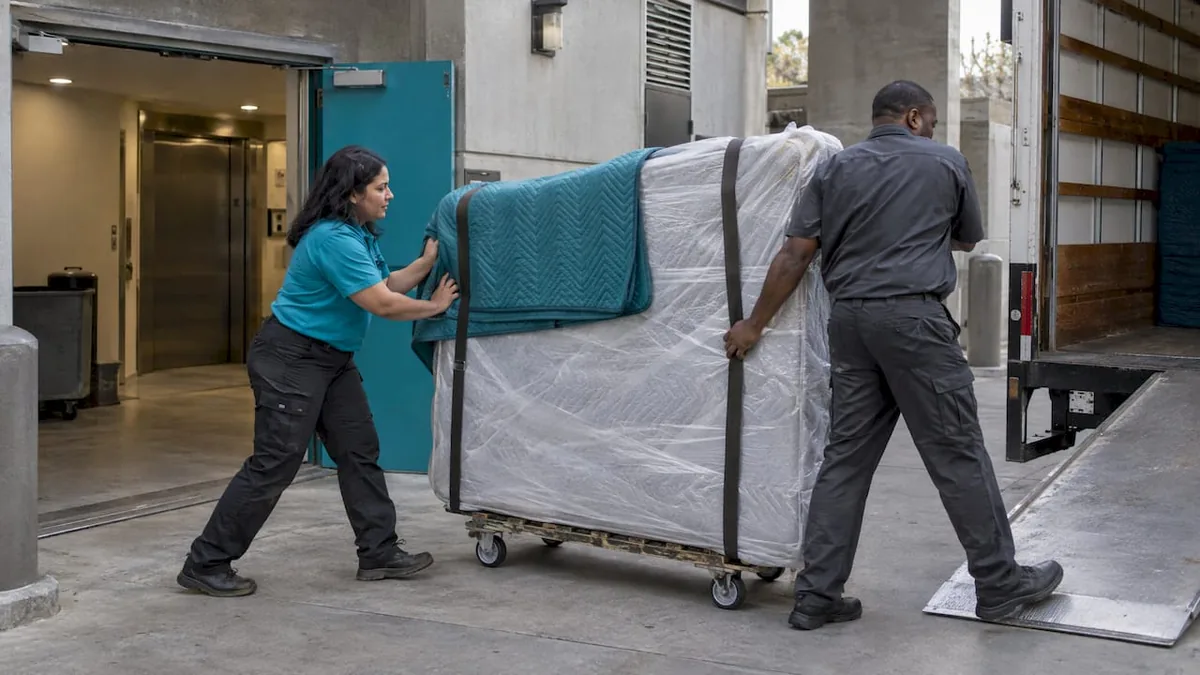

The right warehouse moving company gives you a documented scope, a written estimate, its own trained crews and one person accountable from the first walkthrough to the last pallet placed. At Impel Moving, a locally owned Bay Area mover, that is how our warehouse and industrial moves are set up. This guide explains what to expect, how to plan, what moves the cost, and how to check a mover’s credentials before you sign.
TL;DR
- Start planning early. Guidance from logistics professionals puts a large warehouse move at six to twelve months of preparation, and movers can be booked months ahead.
- Ask for a written estimate built on a documented scope, so racking, equipment, dock access and timing are priced before move day and not discovered on it.
- Verify the mover’s California permit, US DOT number and certificate of insurance before you sign.
- Treat the move as a project with one owner on your side and one coordinator on the mover’s side.
- Impel Moving uses its own uniformed, trained employees, never day labor, and offers a free written moving estimate.
Table of Contents
- What a warehouse moving company actually does
- Plan the move as a project, not an errand
- How to reduce downtime during the move
- What affects the cost of a warehouse move
- How to check a warehouse mover before you hire
- Safety on the warehouse floor
- Warehouse moves and other business moves
- Our perspective
- Get a written estimate for your warehouse move
- FAQ
- Sources
What a warehouse moving company actually does
A warehouse move is not a bigger apartment move. Your operation is usually still running while you move it, and the goods are heavy, palletized, racked or tied to equipment. A warehouse mover’s job is to take your floor from one site to another with as little interruption as possible.
The work normally falls into a few parts:
- Site walkthrough and scope. Someone looks at both buildings: dock doors, floor loading areas, aisles, elevators if any, and the equipment that has to travel.
- Dismantling and packing. Shelving, workstations, pallet racking and loose stock are taken down, labeled and protected.
- Transport and placement. Items arrive in the order you need them and are set in the positions on your new layout.
- Reassembly and cleanup. Shelving and fixtures go back up, and packing material and unwanted furniture are cleared.
On the Bay Area side, our crews work San Francisco, the Peninsula, Silicon Valley and Marin every day. That matters for warehouse space in places where loading docks are tight, streets are narrow and building rules on access hours are strict.
Plan the move as a project, not an errand
The most common warehouse relocation problem is late planning, not a damaged pallet. The Logistics Bureau says a large warehouse may take six to twelve months to plan, and that the move needs coordination across property, operations, IT, HR, finance and safety. It recommends a steering group, a project manager and tracked workstreams for site feasibility, layout, inventory mapping and equipment dismantling.
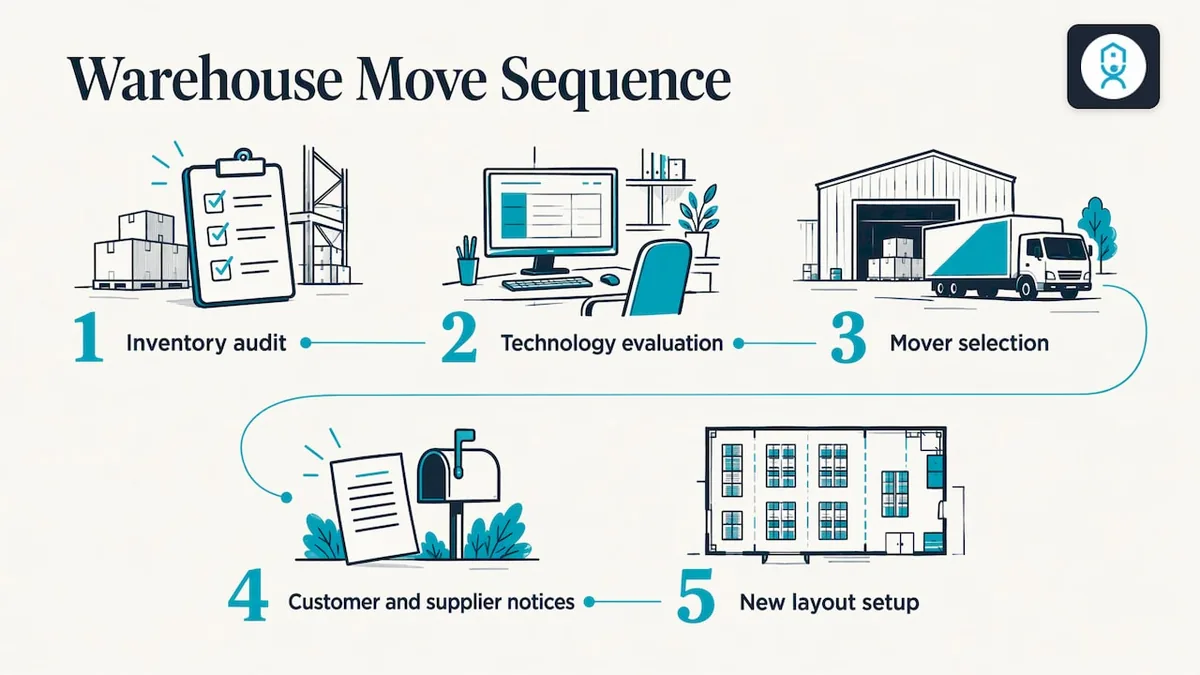
ShipBob’s guide gives a similar window: start 6 to 12 months before the target date and work backward from milestones such as an inventory audit, technology evaluation, mover selection, customer and supplier notification, and new layout setup, with buffer time for delays.
Smaller operations will not need a year, but the order holds. Here is a working sequence.
1. Audit what you own
Count what you have before you decide what moves. Prologis suggests considering whether to eliminate aged or dead inventory instead of paying to move it. Every pallet you do not move is time and labor you do not pay for, and it is the cheapest way to shorten the job.
Mark fragile items clearly at this stage. Separate stock into what must be live on day one in the new building and what can wait.
2. Draw the new layout first
Before anything leaves, know where every rack, bench and pallet position goes in the new building. A crew that has a layout can place items once. A crew without one moves things twice. Share the plan with your mover during the walkthrough so the scope reflects it.
3. Book the mover early
Prologis advises booking early because movers are sometimes booked months in advance. In the Bay Area, quarter-end and lease-end dates create the same crunch. If your lease ends on a fixed date, call for a free written estimate as soon as you have a target window.
4. Decide who tells whom
Because the warehouse is usually operating during the move, Prologis notes you must decide who is informed and what each person’s role is. Tell customers, suppliers and carriers which days shipping will slow. Build an emergency contact list that covers the mover, your staff, vendors, utilities and key customers.
5. Set a staffing schedule
Your own team still has jobs to do. Write a schedule for the move period so the people who know the stock are on site when it is unloaded, and the people running orders are not pulled into packing.

How to reduce downtime during the move
Downtime is the real cost of a warehouse move, more than the labor. A few practices keep it small:
- Stage the move in phases. Move slow-turn stock and non-critical equipment first, and keep the active pick area running as long as you can.
- Label by destination, not by origin. Labels should say where an item goes in the new building, so the crew can place it without asking.
- Move IT and scanning equipment on a plan. Warehouse management terminals, printers and network gear need their own sequence. If you have servers or network racks, our IT and server relocation service and our server room relocation checklist cover that part.
- Schedule around your peak season. If your busiest weeks are predictable, avoid them, and confirm dock and building access hours at both sites in writing.
- Keep one decision-maker available. Questions on move day should be answered in minutes. That is why we assign one coordinator from quote to placement, and why you should name one person on your side.
What affects the cost of a warehouse move
A warehouse move has no single price because no two warehouses hold the same things. What you should budget for is more than the mover’s invoice. ShipBob lists moving services, equipment rentals, temporary storage, new shelving, technology setup, production downtime, extra labor, utility deposits, permit fees, signage and IT infrastructure among the items a warehouse move budget should include.
On the mover’s side, the factors that shape the estimate are:
| Factor | Why it changes the estimate |
|---|---|
| Volume and type of stock | Palletized goods, loose cartons and heavy items need different handling |
| Racking and shelving | Dismantling and reassembly take crew time at both ends |
| Equipment | Machinery, workstations and IT gear need protection and sequencing |
| Access at both sites | Dock height, elevators, stairs, parking and building rules |
| Distance and route | Local Bay Area moves differ from long-distance relocations |
| Packing needs | Whether the crew packs, or your team does |
| Timing | After-hours or weekend work, and phasing the move |
| Disposal | Old furniture or fixtures you are not taking with you |
We do not publish a flat price for warehouse moves, because a number given before anyone sees the space is a guess. Our costs come from a written estimate based on a documented scope. If you want a rough orientation first, we publish planning ranges at impelmovingca.com/rates. They are planning ranges, not quotes, and the final cost comes from the written estimate. For local moves, we have a three-hour minimum.
The point of a documented scope is to keep move day honest. When the estimate is written from a real walkthrough, we do not add charges on move day for work that should have been seen.
How to check a warehouse mover before you hire
A warehouse holds your inventory, which is your revenue. Check the mover as you would check a supplier. Here is the sequence.
- Confirm the business is local and the crew is its own. Ask whether the people on your floor are the mover’s employees or day labor. Our crews are Impel’s own uniformed, trained employees, never subcontractors or day labor.
- Ask for the California permit and the US DOT number. In California, household goods and many commercial movers operate under a state motor carrier permit. Ours is Cal-T / MTR 0192323, and our US DOT number for long-distance moves is 3549568. The federal agency FMCSA stopped using separate MC numbers on October 1, 2025, consolidating carrier identification under USDOT numbers, so the DOT number is the one to look up.
- Request a certificate of insurance (COI). A COI is a document from the insurer showing what coverage the mover carries. Your landlord may also require one before any crew enters the building. Our licensing, insurance and COI page explains what we provide.
- Understand the federal minimums. Federal rules at 49 CFR 387.9 set a minimum of $750,000 in public liability coverage for general freight carriers. That is a floor for carriers. Ask what coverage applies to your goods and your building, and get it in writing.
- Get the scope and estimate in writing. It should name both addresses, the equipment, the racking, the packing, the access conditions and the schedule.
- Ask who your single contact is. You want one coordinator who knows the whole job.
That last check is simple and revealing. If a company cannot tell you who will run your move, expect to repeat yourself on move day.
Safety on the warehouse floor
Warehouse work involves powered equipment, heavy loads and tight spaces. Whoever works in your building should be trained and supervised, and the work should follow your site rules and your landlord’s. Share your site safety rules, dock procedures and restricted areas with the coordinator before the move so the crew follows them from the first hour. If your own staff operate forklifts or other powered equipment during the move, confirm their training is current, since OSHA requires formal operator training and periodic evaluation.
Warehouse moves and other business moves
Many Bay Area businesses are not only warehouses. A distributor may have a front office and showroom attached to its storage. A retailer may hold stock in the back of the store. In those cases the move should be planned as one project with one coordinator, not as separate jobs with separate contacts.
- If the warehouse has an attached office, our office movers handle desks, workstations and files, and the office relocation checklist helps you sequence it.
- If you hold stock behind a storefront, our retail store relocation service covers fixtures and merchandise.
- If the move is part of a wider company relocation, corporate relocation brings the sites together under one plan.
- If you are moving out of the Bay Area, our long-distance moving runs under our US DOT number.
Our perspective
We are a locally owned and operated Bay Area moving company, not a franchise and not a broker. That matters most on a warehouse job, because the company that wrote your estimate should be the company whose crew shows up.
Our view is that most warehouse move problems begin before move day. They begin when the scope is vague, when the new layout is not ready, or when nobody owns the schedule. So we start with a documented scope and a written estimate, and one coordinator stays with the job from quote to placement.
We also think you should know who is on your floor. Our crews are our own uniformed, trained employees, never day labor, and we are licensed and insured under Cal-T / MTR 0192323 and US DOT 3549568. Ask any mover for the same details, and expect them in writing.
Plan early, label for the destination, and decide what not to move. Do those three things and the move gets shorter and cheaper, whoever you hire.
Julia
Get a written estimate for your warehouse move
If you are planning a warehouse or industrial move in San Francisco, the Peninsula, Silicon Valley or Marin, our warehouse and industrial movers page describes how we work. We walk the scope with you, document it, and give you a free written moving estimate with one coordinator assigned from quote to placement.

If the move also includes packing, our packing services and furniture assembly and disassembly can be written into the same estimate, and furniture disposal clears what you are leaving behind.
FAQ
How far ahead should I book a warehouse moving company?
As early as you have a target window. Planning guidance from logistics professionals puts a large warehouse move at six to twelve months of preparation, and movers can be booked well ahead. For a smaller operation, call as soon as your lease or move date is set, then request a free written estimate.
Can the warehouse keep operating during the move?
Usually it has to. Warehouses are normally still running during a relocation, so the best approach is to plan the move around ongoing operations, assign roles and phase the work. Move slow-turn stock first and keep active picking areas running as long as possible.
What should a warehouse mover’s estimate include?
It should name both addresses, the stock and equipment being moved, racking and shelving work, packing, access conditions at both sites, and the schedule. Our estimates are written from a documented scope, so move-day charges are not added for work that should have been seen. The final cost always comes from the written estimate.
What credentials should I ask a warehouse mover for?
Ask for the California motor carrier permit, the US DOT number and a certificate of insurance. Ours are Cal-T / MTR 0192323 and US DOT 3549568, and our licensing and COI page lists what we provide. Check that the coverage satisfies your landlord’s requirements.
Do you move offices and servers as part of a warehouse relocation?
Yes. We handle office relocation and IT and server relocation, so an attached office or server room can be planned in the same project as the warehouse floor.
Sources
- Warehouse Relocation: 10 Things You Need to Consider, Logistics Bureau
- Your Complete Guide to Warehouse Relocation, ShipBob
- To-Do List for Moving a Warehouse, Prologis
- FMCSA Rule Updates for 2025 and What Fleets Need to Know, FreightWaves
- Trucking Insurance Requirements, Fast Trucking Compliance
- How to Start a Supply Chain Business: Steps and Licenses, LegalClarity