An appliance moving service sends a trained crew with the right equipment to disconnect-ready, protect, carry and place your refrigerator, washer, dryer, dishwasher or range, so nothing gets dropped, scratched or tipped on the way. In the Bay Area, where many homes mean narrow stairs, steep curbs and elevator reservations, the safest route is to hire licensed movers for the carrying and a licensed technician for any gas or plumbing line. At Impel Moving, appliances travel with the rest of your household as part of a documented, written-estimate move handled by our own crew.
Key Takeaways
- Professional appliance moving is mostly about handling: dollies, straps, floor protection and a crew that has carried heavy loads through tight stairwells and doorways.
- Gas lines and water lines are a separate job. Some movers cannot disconnect or reinstall certain items such as gas dryers, so plan for a licensed technician where a line is involved.
- Third-party estimates put professional refrigerator moving at $100-$300, averaging $220, usually on top of the base moving charge. Your final cost should come from a written estimate.
- Before you book, confirm the mover is licensed in California and that the estimate names charges, payment method and what damage is covered.
- Refrigerators and top-load washers have manufacturer rules (upright handling, drying, shipping material) that a good crew follows and that you can follow when you prep.
Table of Contents
- What an Appliance Moving Service Actually Includes
- Who to Hire for a Refrigerator, Washer or Dryer
- What Appliance Moving Costs
- How to Verify a Mover Before You Book
- Preparing Appliances for the Move
- Moving Appliances Into or Out of Storage
- Can You Move a Heavy Appliance Yourself?
- Appliances in Business Moves
- Our Perspective
- Get Your Appliances Moved With the Rest of Your Home
- FAQ
- Sources
What an Appliance Moving Service Actually Includes
The heavy part of the job is obvious: a full-size refrigerator, a stacked washer and dryer or a freestanding range is awkward, dense and easy to damage. What you pay a professional for is less obvious:
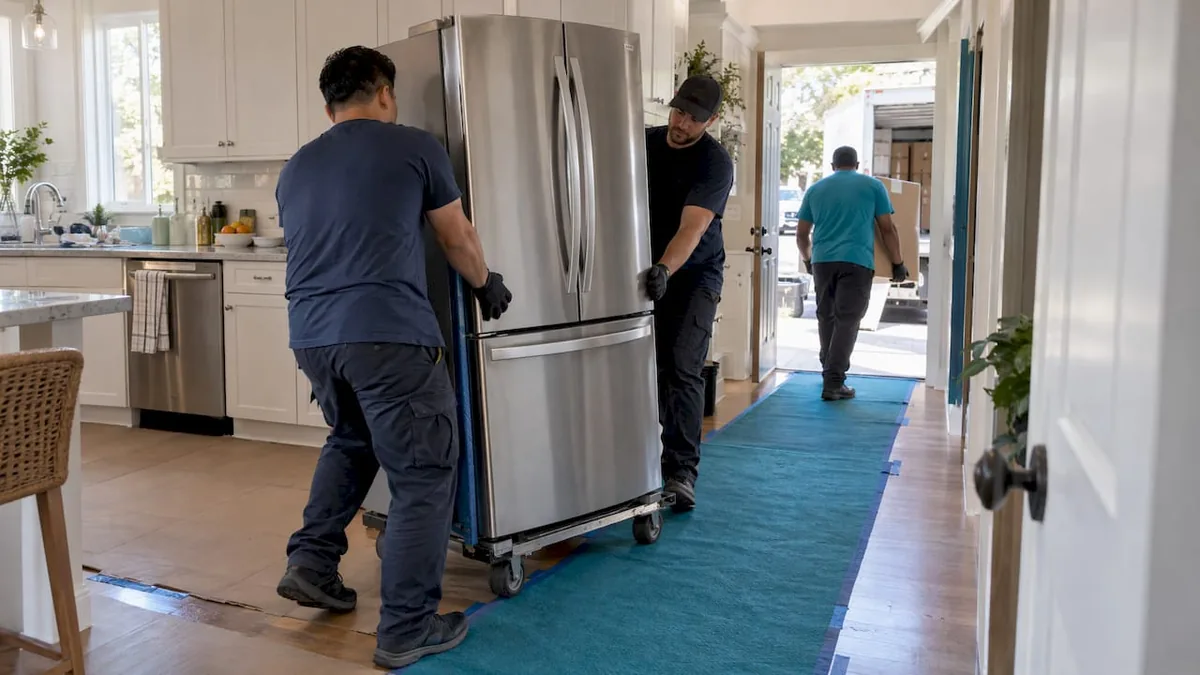
- Equipment and technique. Appliance dollies, straps, moving blankets and floor protection, plus crew members who know how to turn a heavy unit on a staircase.
- Route planning. Measuring doorways, hallways, stair turns and elevator cabins before the move, so the appliance fits where it needs to go.
- Protection. Doors secured, loose shelves and trays removed or wrapped, and surfaces padded so the finish survives the trip.
- Placement. Setting the unit in its final spot, level and ready for a technician to connect if a line is involved.
What a mover does not always include is the connection work itself. Yahoo Local’s moving guide notes that not all professional movers can disconnect or reinstall certain items, such as gas dryers, so you may need a separate licensed professional for line connections. That is a safety boundary, not a gap in service: gas work belongs with a qualified technician. This Old House also recommends a qualified technician for gas-line disconnection.
Who to Hire for a Refrigerator, Washer or Dryer
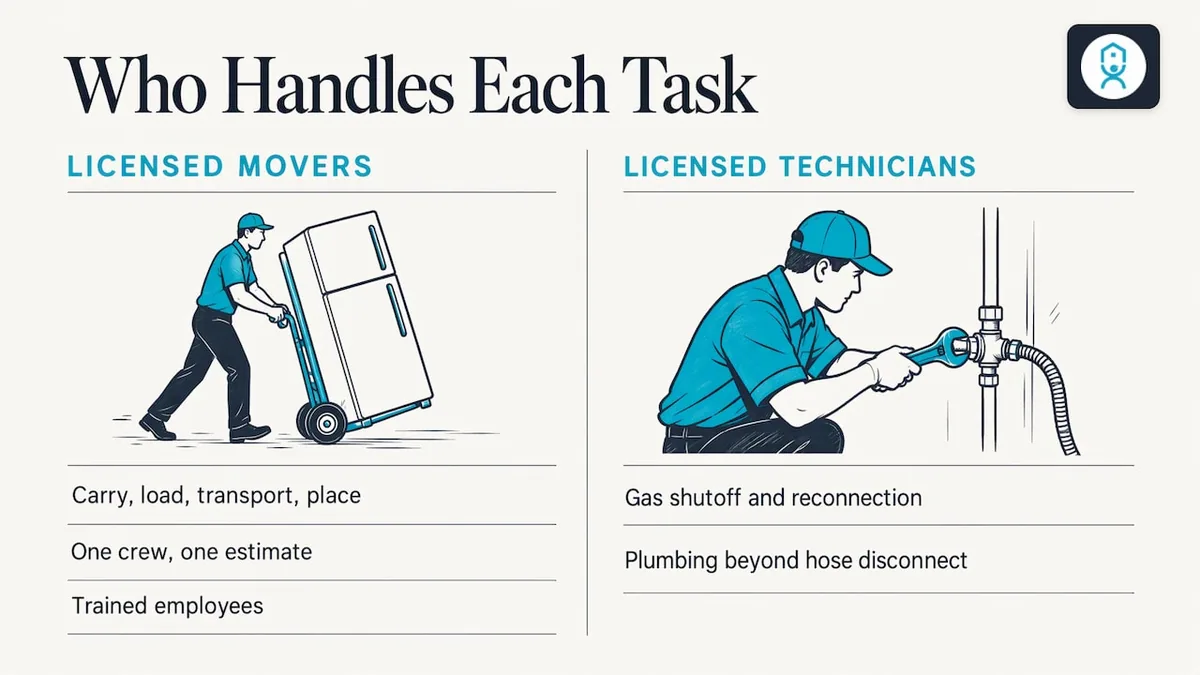
Two kinds of professionals are involved, and it helps to know which does what.
Licensed movers carry, load, transport and place the appliance. If you are moving the whole household, the appliance should ride with everything else, under one estimate and one crew. That is how we approach it at Impel Moving: our uniformed, trained employees, never day labor, with one coordinator from quote to placement. Our residential movers and apartment movers pages describe how those moves run.
A licensed appliance or gas technician handles gas line shutoff and reconnection, and any plumbing work beyond a simple hose disconnect. Whirlpool’s guidance says to contact a professional appliance technician for gas-line work, since movers may decline liability for it. If your dryer or range is gas, book the technician for both ends of the move.
If you are only moving one appliance across town, the same logic applies: you want trained people, the right equipment and a written estimate, not a favor from a friend with a borrowed hand truck.

What Appliance Moving Costs
Appliance pricing is where readers get the least clear information, so here is what can be said reliably.
A widely cited estimate relayed by Yahoo Local puts professional refrigerator moving at $100-$300, averaging $220, typically in addition to the mover’s regular charges. The same source says water-line or gas disconnection may cost extra. Treat those as national reference points, not Bay Area prices.
What moves the number:
- Type and size of the appliance. A side-by-side refrigerator with a water line is more work than a compact unit.
- Stairs and access. A fourth-floor walk-up in the Mission or a hillside home in Marin is different from a ground-floor garage entry in Sunnyvale.
- Elevators. Many San Francisco condo and apartment buildings require you to reserve the freight elevator, and the timing affects the schedule.
- Line work. Gas, water and ice-maker connections are often a separate technician charge.
- Distance. Across the street is not the same as San Francisco to San Jose, and long-distance moves follow different rules.
On costs with Impel Moving, the final number always comes from a written estimate based on a documented scope, and our estimate is designed so that work that should have been seen does not become an added charge on move day. Where we discuss budgeting, we use the planning ranges published on our rates page, and local moves carry a three-hour minimum. You can get a free written moving estimate once you know what is moving.
If you are comparing the cost of hauling things yourself, equipment rental adds its own variables; for instance, utility trailer rental costs depend on trailer size and rental length, and you would still need people to load heavy units safely.
How to Verify a Mover Before You Book
An appliance can do real damage to a floor, a wall or a person, so the mover’s credentials matter as much as the price. California’s Bureau of Household Goods and Services (BHGS) says in its Consumer Guide to Household Moving that companies moving household goods within, into or out of California must be licensed by BHGS, and that interstate moves into or out of California also require FMCSA licensing. FMCSA is the Federal Motor Carrier Safety Administration, the federal agency that oversees interstate movers.
Use this checklist:
- Check the license. Ask for the California permit number and, for interstate work, the U.S. DOT number, and look both up. Our guides on what a licensed moving company means and how to verify an interstate mover walk through the steps. Impel Moving operates under California permit Cal-T / MTR 0192323 and US DOT 3549568 for long-distance moves.
- Get a written estimate after a visual inspection. BHGS advises comparing written estimates after the mover has seen what is moving. The estimate should identify charges, payment method, insurance type and what damages are covered.
- Document your belongings. Photograph each appliance, including existing scratches and dents, before the move.
- Sign the paperwork before work starts. BHGS says to sign the moving agreement or bill of lading (the contract and receipt for your goods) before the crew begins.
- Ask who is doing the work. Employees who work for the company are accountable to it. Our crews are Impel’s own uniformed, trained employees, and our careful handling page explains how we protect belongings.
Preparing Appliances for the Move
Good prep makes the move faster, lowers the chance of leaks and damage, and lets the crew start carrying rather than troubleshooting. Always check the manual for your model first.
Refrigerators and freezers
- Whirlpool’s moving instructions say to turn off the ice maker and remove food two to three days before moving, then defrost, clean and dry the unit.
- Whirlpool’s heavy-appliance guide advises defrosting for at least 6-8 hours, disconnecting power and water, and securing shelves and doors.
- Pack removable shelves and glass components separately. If you need help with fragile items, see our guide to packing dishes and glasses.
Washers
- GE Appliances’ moving instructions say to unplug the washer, reinstall the shipping material if you still have it, shut off and remove the water hoses, drain them and store them in the washer basket.
- The same guidance says top-load and unitized washers must be shipped upright to prevent damage to the suspension or the inner and outer tubs. Tell your crew which type you have.
Dryers, dishwashers and ranges
- Unplug, clean lint traps and vents, and coil and secure cords.
- Remove or secure loose parts such as racks and trays, and secure doors, as This Old House recommends, which also suggests starting prep at least 24 hours ahead.
- Gas models need a qualified technician to shut off and cap the line.
Clear the path
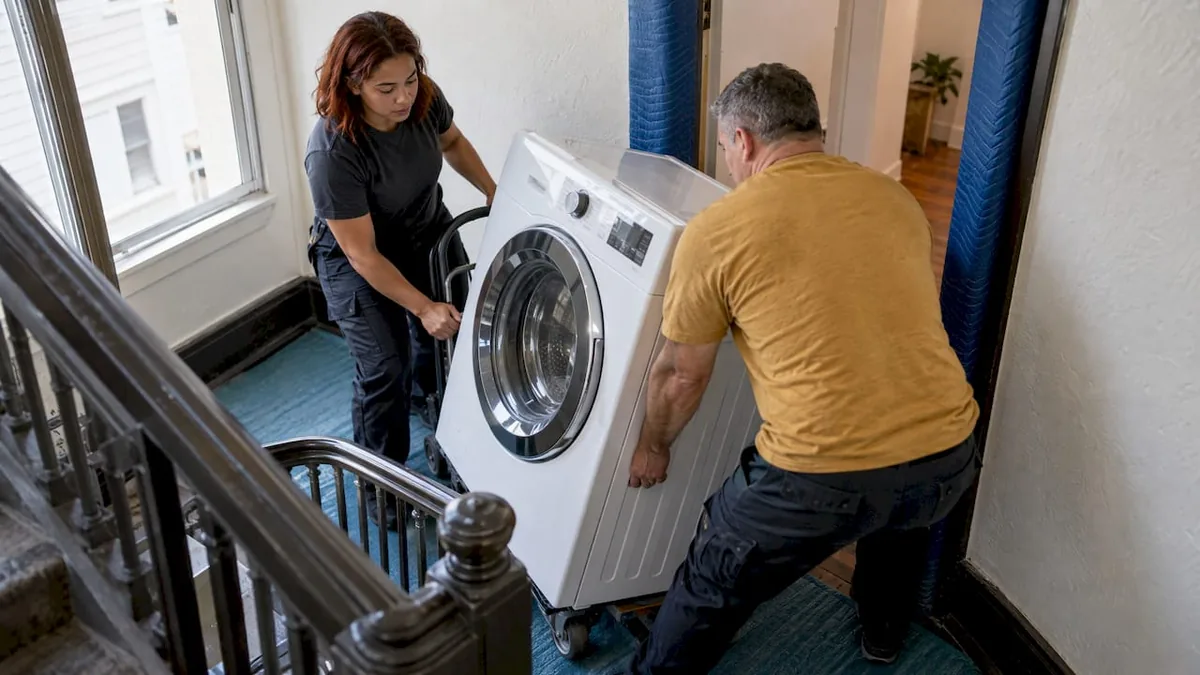
Measure doorways, stairwells and elevator cabins, and clear the route. In older San Francisco buildings with tight landings, a few inches decide whether an appliance fits. Telling the crew about the stairs at the estimate stage keeps the plan accurate.
Moving Appliances Into or Out of Storage
Storage is not just parking an appliance. Manufacturer guidance is specific:
- Dry and ajar. Whirlpool says a refrigerator should be dry before storage, with doors secured ajar for airflow.
- Temperature. Whirlpool recommends avoiding extreme storage temperatures and says climate-controlled storage is best.
- Upright handling. Keep refrigerators upright, use a weight-rated dolly with straps, and pack shelves and glass components separately where possible.
When you take an appliance out of storage, give it time to settle upright before plugging it in, and follow the manual’s startup guidance. If a storage unit is up several flights or down a long corridor, mention it when you request your estimate so the route is planned in advance.
Can You Move a Heavy Appliance Yourself?
Some people can, with the right help. Whirlpool advises at least one helper, tilting the unit slightly to slide a hand truck underneath, strapping it down, and tilting the hand truck back no more than 45 degrees. This Old House says never to lift heavy appliances alone, to use furniture sliders and floor protection, and to hire professional movers or installers if you are not comfortable with any part of the job.
Stairs, tight turns and hardwood floors are where DIY moves go wrong. If your route has any of them, a crew is the safer choice, and for a full move it is also the simplest one: one estimate, one team and the appliance placed where you want it.
Appliances in Business Moves
Offices, medical practices and restaurants move appliances too: break-room refrigerators, commercial kitchen equipment, dental sterilization units. Those moves work best when the appliance schedule is part of the larger relocation plan. Our restaurant movers, medical and dental office movers and office relocation pages explain how we plan business moves around the equipment that matters most.
Our Perspective
Most appliance damage we hear about in the moving industry comes from the same few causes: unplanned routes, rushed prep and unclear responsibility. A refrigerator does not forgive a tilted stairwell, and a washer shipped on its side does not forgive anyone.
That is why we start with a documented scope. Before the move, we want to know what is moving, where it goes, how many stairs or elevators are between the two points and which items need a technician. That information becomes a written estimate, and the written estimate is what you hold us to.
Our crews are Impel’s own uniformed, trained employees, and you have one coordinator from quote to placement. Standard residential moves include furniture protection plus furniture disassembly and reassembly, so the pieces around your appliances are protected too.
If you take only one thing from this article, let it be this: hire a licensed mover for the carrying, a licensed technician for the gas and water lines, and put every charge in writing before the move.
Julia
Get Your Appliances Moved With the Rest of Your Home
Impel Moving is a locally owned Bay Area moving company, not a franchise or a broker. We work in San Francisco, the Peninsula, Silicon Valley and Marin every day, and every move gets a documented scope, a written estimate and one coordinator from quote to placement. If you are packing a kitchen, our packing services and full moving service take the boxes off your list.

To get started, request a free written moving estimate and tell us about your appliances, the stairs and the elevator situation. For local moves in San Francisco, see our San Francisco movers page, and for Peninsula and Silicon Valley homes, our San Carlos and Santa Clara pages.
FAQ
How much do movers charge to move a refrigerator?
A national estimate relayed by Yahoo Local puts professional refrigerator moving at $100-$300, averaging $220, often on top of the base moving charge. Water-line work can cost extra. For an Impel Moving move, the final cost comes from a written estimate based on your documented scope.
Who do I hire to move a washer and dryer?
Hire licensed movers to carry and place them. If the dryer is gas, hire a qualified technician to disconnect and reconnect the line, since not all movers can do that work. A single estimate covering both steps avoids surprises.
Do I need to defrost my refrigerator before moving?
Yes. Whirlpool says to turn off the ice maker, remove food two to three days ahead, then defrost, clean and dry the unit. Its heavy-appliance guide suggests allowing at least 6-8 hours for defrosting.
Can a washer be moved on its side?
Not a top-load or unitized model. GE Appliances says these must be shipped upright to protect the suspension and tubs. Tell your crew which type you own so it is handled correctly.
How do I check that an appliance mover is legitimate?
Check the license first. California’s BHGS says companies moving household goods within, into or out of California must be licensed, with FMCSA licensing added for interstate moves. Then get a written estimate and sign the agreement before work begins.
Sources
- Should you move your appliances yourself or hire professionals (Yahoo Local)
- Consumer Guide to Household Moving (California BHGS)
- Tips for Moving Your Appliances (This Old House)
- Preparing for Vacation or Moving (Whirlpool)
- How to Move Heavy Appliances (Whirlpool)
- Top Load and Unitized Washers Moving Instructions (GE Appliances)
- Utility Trailer Rental: Sizes, Costs and What to Know