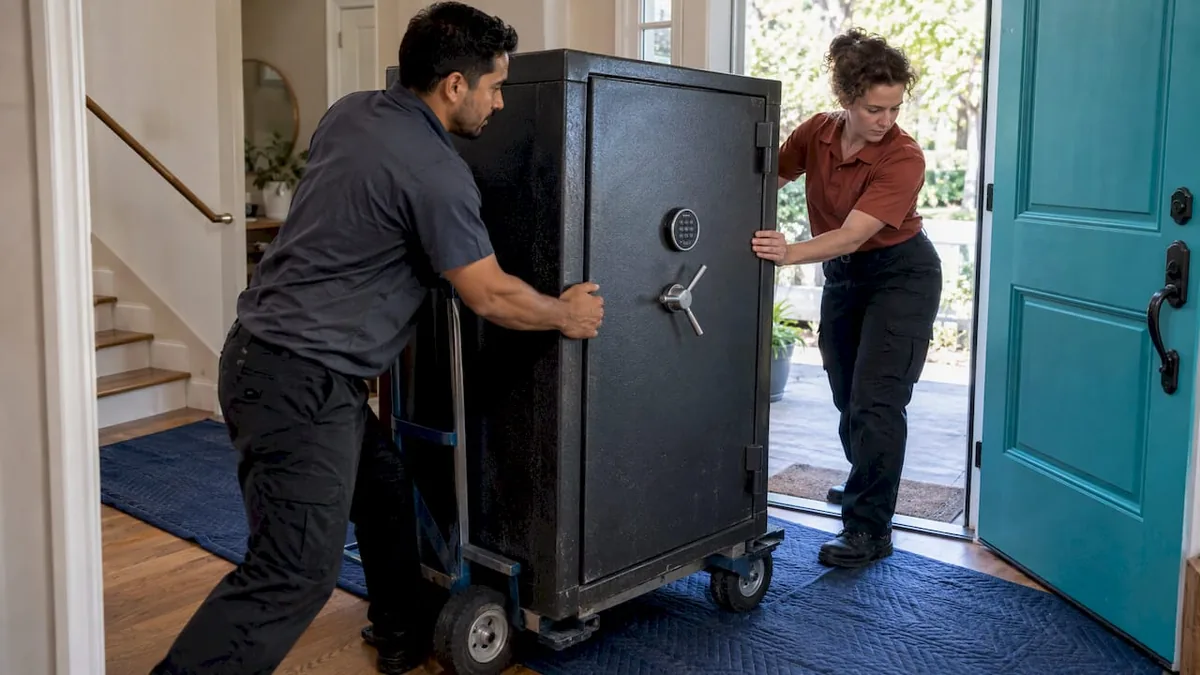

A licensed moving company is one that holds the permits your move legally requires. For a move across state lines, that means a U.S. DOT number and federal authority to move household goods. For a move within one state, it means the license that state issues. In California, that is a Household Mover License from the state’s Bureau of Household Goods and Services (BHGS). This guide explains the difference, shows you how to verify any mover in a few minutes, and lists the warning signs that matter.
TL;DR
- Interstate movers need a U.S. DOT number and must be authorized by the FMCSA to move household goods. Rules for moves within a state vary by state.
- In California, anyone paid to move household goods needs a BHGS license, whether the move is local or crosses the state line.
- Check the license before you sign: the FMCSA search tool for interstate movers, your state agency for in-state movers.
- Insist on a written estimate based on an in-person or documented inspection, and treat a rock-bottom online quote as a warning sign.
- A license is the baseline, not a promise of quality. Look at who does the work, how it is priced and how it is insured.
Table of Contents
- What “licensed mover” means in the United States
- Licensed movers in California
- How to verify a moving company’s license, step by step
- What a license does and does not tell you
- Estimates and paperwork a licensed mover should provide
- Red flags that a mover’s credentials are missing or misleading
- Questions to ask any licensed mover
- Perspective: why the license is only the starting line
- Moving in the Bay Area with a licensed, insured team
- FAQ
- Sources
What “licensed mover” means in the United States
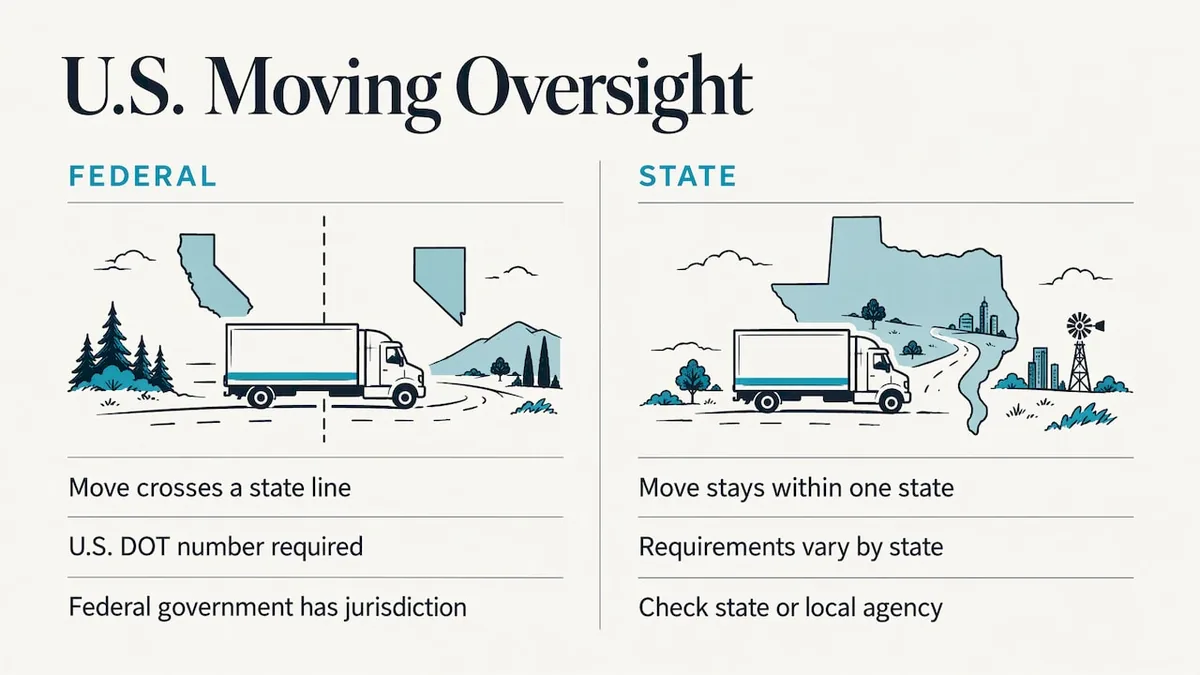
There is no single national moving license. Two layers of oversight apply, and which one governs your move depends on where it starts and ends.
Federal layer. For interstate moves, a U.S. DOT number is required by the FMCSA, and you should make sure the mover is authorized to move household goods. If a shipment crosses a state line, jurisdiction falls to the federal government, not the state.
State layer. For moves within a state, requirements vary. The FMCSA advises you to check with your state, county or local consumer affairs agency or the state attorney general. Several states run their own licensing programs, and the details differ, as the table below shows.
So when a company says it is “licensed,” ask the follow-up question: licensed by whom, for which kind of move? A mover with a valid state license may still lack federal authority to cross state lines, and the reverse can also be true.
Registered is not the same as authorized
This is the detail most people miss. The FMCSA explains that a registered moving company is different from an authorized one. A company can be registered with the federal government and still not be authorized to move household goods. Interstate moving companies and brokers must be registered and have a U.S. DOT number, but registration alone does not tell you the company can legally move your furniture.
Brokers are a separate case. According to the same FMCSA page, brokers do not receive an “authorized” designation. They arrange transportation of your household possessions but have no trucks and do not take possession of or responsibility for your goods. That is worth knowing if the company you booked online turns out to send a different company’s truck.
Licensed movers in California
If you are moving in the Bay Area or anywhere in California, the state rules are strict and specific. The California Department of Consumer Affairs’ BHGS states that companies moving household goods within, into or out of California must be licensed with BHGS. Companies moving into or out of California must also be licensed with the FMCSA.
The license type depends on the move. According to the BHGS applicant guidance, anyone paid to move household goods entirely within California needs a Household Mover License, and anyone paid to move only into or out of California needs an Interstate Mover License.
Two California details are worth remembering:
- Paperwork timing. At least three days before your move, the company must give you a moving agreement or Bill of Lading. For moves within California, it should include a “Not to Exceed Price,” the maximum rate you can be charged unless there are change orders (BHGS consumer guide).
- What BHGS does not cover. BHGS does not regulate storage facilities, international moves or moves that do not begin or end in California, according to the same guide. If your move falls outside its reach, the federal rules and other agencies come into play.
BHGS also reports that common complaints include unlicensed household movers, delivery delays, failure to respond to damage claims and charges above the estimate. Those are exactly the problems a license check helps you avoid.
For a Bay Area-specific walkthrough, see our guide on how to check that a San Francisco mover is licensed.
How to verify a moving company’s license, step by step
It takes about ten minutes. Do it before you accept any quote, and again if a different company shows up than the one you booked.
- Get the company’s exact legal name and its license numbers. A legitimate mover can give you its U.S. DOT number and its state license number. Texas, for example, requires these numbers to be displayed on moving trucks, printed on online advertisements and shown on proposals and contracts. Federal rules also require interstate carriers to publish truthful advertisements that include their name and DOT number.
- For any interstate move, use the FMCSA mover search tool. The FMCSA recommends it for checking registered interstate movers and their complaint history. Confirm the company is registered, insured and authorized to transport household goods, and see whether it has received complaints.
- For a move within one state, check with the state. In California, that is BHGS. Other states have their own agencies (see below).
- Match the name. The name on the license, the name on the estimate, the name on the truck and the name on the contract should all be the same company.
- Read the complaint history. The FMCSA also suggests contacting your local Better Business Bureau and consumer protection agencies.
- Keep a record. Screenshot or print the license result and keep it with your contract.
How other states handle it
Moving to or from another state, or helping a relative move elsewhere? Here is how a few state agencies describe their rules. Contact details come from the agencies’ own pages, so confirm on the official site before relying on a phone number.
| State | Who licenses in-state movers | How to verify |
|---|---|---|
| California | BHGS | Check the mover’s license with BHGS; interstate movers also need FMCSA licensing |
| New York | NYS DOT | Call (518) 457-6512 or email nymoving@dot.ny.gov with the mover’s exact name and NYDOT number |
| Texas | TxDMV and USDOT both required | Search the TxDMV “Truck Stop” database by name, TxDMV number or USDOT number |
| Illinois | Illinois Commerce Commission | Confirm on the ICC website; call 217-782-6448 to verify rates on file |
| Washington | Utilities and Transportation Commission | Check permit status with the UTC; for out-of-state moves, check with the FMCSA |
Two extra notes. In Texas, an active TxDMV certificate number means the mover has provided proof of adequate liability and cargo insurance. In Illinois, if your belongings go into storage, the company needs a separate Warehouse License.
What a license does and does not tell you
A license tells you a company has met the legal bar to operate. In Washington, for instance, the UTC says it makes sure permitted companies charge fair and proper rates, carry insurance and keep vehicles safely maintained. It also warns that if you hire an illegal mover, its staff have very limited ways to help when something goes wrong. That is the real value of checking: if there is a dispute, you have an agency with authority to turn to.
What a license does not do is answer every practical question. It does not tell you:
- whether the people who show up are the company’s own trained employees or day laborers;
- how the company handles fragile or high-value items;
- whether packing, unpacking and furniture assembly are included or billed separately;
- how clearly the quote is written.
On that last point, regulators agree that extras are billed as extras. The New York State DOT advises you not to expect free packing supplies or free services such as clean-up or disconnecting and reinstalling appliances. The Illinois Commerce Commission adds that tipping is not required, and that you should ask questions up front if a mover offers freebies like cartons or tape. Ask what is included, in writing, and the surprises disappear.
Estimates and paperwork a licensed mover should provide
Once a license checks out, the next test is the paperwork. This is where legitimate movers separate themselves from the rest.
Get a written estimate based on a real inspection
The FMCSA’s advice is to get a written estimate based on an actual in-person inspection. California’s BHGS likewise recommends that visual inspections, where the mover reviews and documents what is being moved, happen in person. For moves within California, a visual inspection is required with the estimate. A quote given sight unseen from a short phone call is a guess at best.
Know your estimate type
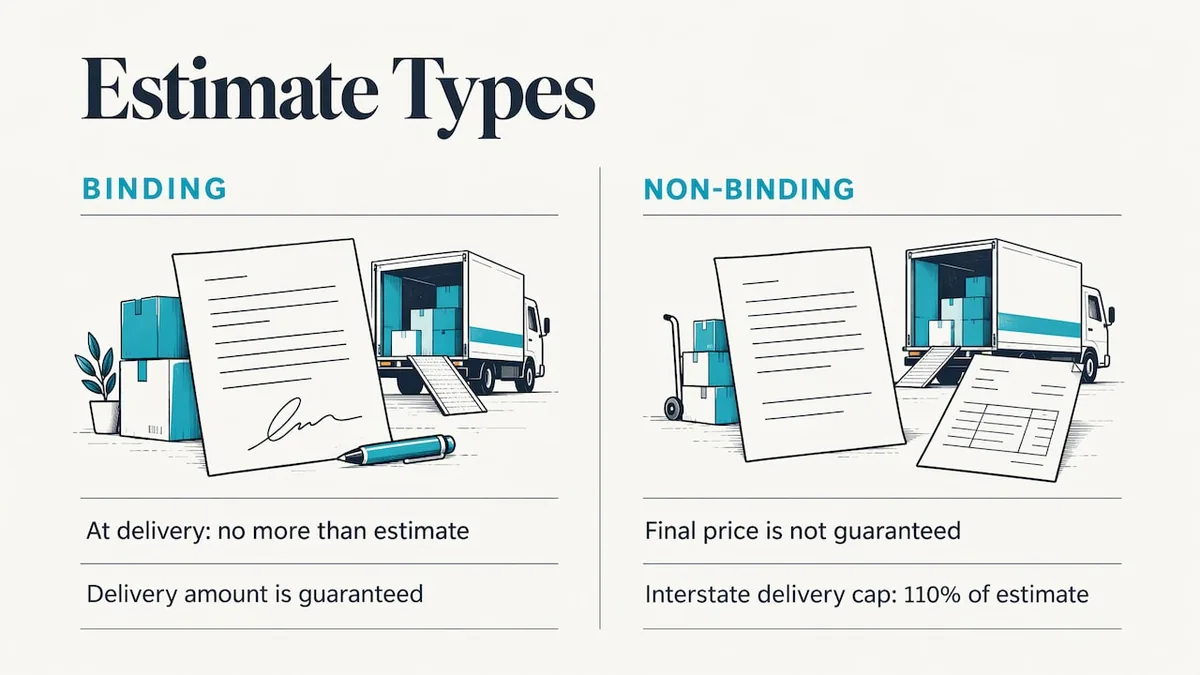
Per the FMCSA, a binding estimate guarantees you will not pay more than the estimated amount at delivery. A non-binding estimate helps determine cost but is not a guarantee of the final price. It should be reasonably accurate based on actual weight, services provided and the mover’s published tariff.
For interstate moves with a non-binding estimate, there is a federal cap. The FMCSA says movers cannot require you to pay more than 110 percent of the non-binding estimate at delivery. The Illinois Commerce Commission gives the practical version: if the estimate was too low, the mover cannot hold your goods if you pay the written estimate plus an additional 10 percent.
If you want help reading the numbers on a quote, our guide to reading a moving quote breaks down the line items, and our page on Bay Area moving costs and written quotes explains how we price.
Documents you should receive before signing
Federal rules require interstate movers to hand prospective customers five things before executing a contract, according to the FMCSA’s household goods consumer protection rule:
- the booklet Your Rights and Responsibilities When You Move;
- a written estimate of charges;
- a summary of the mover’s arbitration program;
- the mover’s customer complaint and inquiry handling procedure;
- the mover’s tariff.
New York adds a practical step for in-state moves: before anything is loaded, make sure you have an “Order for Service” stating how much you will have to pay at delivery.
Red flags that a mover’s credentials are missing or misleading
The federal government treats household goods moving fraud as a real enforcement problem. The DOT Office of Inspector General lists several red flag indicators:
- a website with no local address or FMCSA registration information;
- a generic phone greeting such as “Movers” or “Moving Company”;
- refusal to offer an onsite inspection;
- demands for cash or a large deposit;
- a rental truck arriving on moving day instead of a company-owned, marked truck;
- no copy of Your Rights and Responsibilities When You Move for an interstate move.
The Texas DMV adds unrealistically low prices, no tariff on file, and being rushed through a contract with no paperwork. Its enforcement division notes that unlicensed movers often advertise the lowest price online, with the goal of getting your belongings onto their truck. After that, customers may face high added costs to get their possessions back. Washington’s UTC describes the same pattern: some unlicensed movers keep goods until a large payment is made and illegally increase their estimates.
If two or three of these show up together, stop and verify the license before you pay anything. If you have already booked and spot them, call the state agency or the FMCSA. The FMCSA consumer line for New York shippers is 1 (888) 368-7238, and the same federal agency covers any shipment that has crossed a state line.
Questions to ask any licensed mover
With the license confirmed, use this short list to compare companies fairly.
- Who does the work? Ask whether the crew are the company’s own full-time employees or subcontractors. Employees trained by the company are accountable to it.
- Will the same team handle my whole move? Continuity matters on a long day with fragile items.
- Is the quote written, itemized and based on an inspection? Look for packing, stairs, long carries, assembly and disposal listed by line.
- Is this a binding, non-binding or not-to-exceed price? Know the maximum you could pay.
- What insurance applies, and where is the certificate of insurance? Commercial and building-managed moves often require one.
- What happens if something is damaged? You want a clear claims process.
Our page on licensing, insurance and COI for Bay Area moves shows how we answer these questions for customers.
Perspective: why the license is only the starting line
We think of a license as the minimum a customer should expect, not a reason to choose a mover. Plenty of moving problems happen between licensed companies and their customers, and they usually come down to who shows up and how the price was built.
That is why we run Impel Moving the way we do. We employ full-time, trained staff rather than subcontractors, so the people carrying your furniture work for us, follow our handling standards and answer to us. We assign one dedicated team to each move, so the crew who walks through your home with you is the crew that loads, drives and unloads.
We also put pricing in writing and keep it clear. A customer should be able to read a quote and know what is included before anyone touches a box. Because we are family-owned and based in the Bay Area, we plan around the logistics that make local moves harder: tight streets, parking permits, elevators and older buildings with narrow stairs.
Our advice is simple. Verify the license, then judge the mover on the people, the paperwork and the planning behind the move. That is the standard we hold ourselves to, from the first walkthrough to the follow-up after the last box is unpacked.
Julia
Moving in the Bay Area with a licensed, insured team
Impel Moving is a family-owned company handling residential and commercial moves around the Bay Area. We are a licensed, insured moving company with full-time staff, one dedicated team per move and clear written quotes, with support from planning through post-move follow-up.
What we move depends on your situation:
- Homes and apartments: our residential movers and local movers handle everything from studios to large homes.
- Everything handled for you: our full moving service covers packing, loading, transport and unpacking.
- Leaving the Bay Area: see our long distance moving page, or read about whether your things stay on one truck from SF to LA.
- Offices and businesses: our commercial movers cover office, retail, medical, restaurant and warehouse relocations.
- Valuables: learn how we handle art, antiques and valuables and protect your belongings.
Ready to plan your move? Start at impelmovingca.com and request a written quote.
FAQ
Is a licensed mover the same as an insured mover?
No, though the two are related. A license shows the company is authorized to operate, while insurance covers specific risks such as liability and cargo. Some regulators check insurance as part of licensing. For example, an active TxDMV certificate number means the mover has provided proof of liability and cargo insurance. Always confirm both, and ask for the certificate if your building requires one.
Do I need a licensed mover for a move within California?
Yes. BHGS states that anyone paid to move household goods entirely within California must hold a Household Mover License. Moves into or out of California need an Interstate Mover License from BHGS, plus FMCSA licensing. Check the license before you sign.
What is the difference between a mover and a moving broker?
A mover has the trucks and crews and takes responsibility for your goods. According to the FMCSA, a broker arranges transportation for your household possessions but has no trucks and does not take possession of or responsibility for the goods. Ask directly which one you are hiring.
Can a mover charge more than the estimate?
It depends on the estimate type. A binding estimate guarantees you will not pay more than the estimated amount at delivery. With a non-binding interstate estimate, the FMCSA says the mover cannot require more than 110 percent of the estimate at delivery. For moves within California, look for the Not to Exceed Price in your agreement.
What should I do if I think I hired an unlicensed mover?
Contact your state moving regulator, which is BHGS in California, or the FMCSA if the move crosses state lines. Keep every document, estimate and payment record. Washington’s UTC notes that its staff have limited ways to help when an illegal mover is hired, so verifying first is far easier than fixing it afterward.
Sources
- Steps to Select a Mover, FMCSA
- Are FMCSA registered moving companies the same as FMCSA authorized?
- How can I avoid unexpected moving costs? FMCSA
- FMCSA Issues Rule Enhancing Household Goods Consumer Protection
- Consumer Guide to Household Moving, California BHGS
- Household Moving Applicants, California BHGS
- Moving, New York State DOT
- TxDMV Smart Buyer Series: Smart Moves
- Licensed? Illinois Commerce Commission Smart Tips
- Choosing a Licensed Mover in Washington State, UTC
- Household Goods Moving Fraud, DOT OIG