Furniture delivery and assembly means a crew brings your furniture to the right room, builds it, and leaves the space clear of packaging. The details behind that promise vary a lot from one provider to the next. In San Francisco, the Peninsula, Silicon Valley and Marin, building rules, steep streets and tight stairwells make the details matter even more. At Impel Moving, our own uniformed, trained crews handle furniture assembly and disassembly and white glove delivery, and every job starts with a written estimate based on a documented scope.
TL;DR
- “White-glove” has no single definition. Some stores only carry the box inside, so confirm in writing whether placement, assembly and packaging removal are included.
- Retail white-glove fees typically run $60-$400 according to Consumer Reports (2020 figures), depending on distance and order total.
- Measure the whole route, not only the destination room: doors, hallways, stair turns and elevators decide whether a piece arrives intact.
- Large or tall pieces such as wardrobes, bunk beds and dressers should be assembled by a professional and anchored to the wall.
- For moves in the Bay Area, ask for a free written moving estimate so assembly, placement and disposal are all in the scope before moving day.
Table of Contents
- What furniture delivery and assembly services include
- Can furniture be delivered already assembled?
- What white-glove furniture delivery adds
- What furniture delivery and assembly costs
- Prepare your home or office before the crew arrives
- When to hire a professional to assemble
- Delivery day: inspect before you sign
- Compare delivery and assembly terms before you schedule
- Old furniture, packaging and the rest of the move
- Perspective: why scope decides the outcome
- How Impel Moving handles furniture delivery and assembly
- FAQ
- Sources
What furniture delivery and assembly services include
A complete service has four parts, and you should know which of them you are buying.
- Delivery to a place. This can be the curb, the first dry area inside the door (often called threshold delivery), or the exact room you choose.
- Unpacking. The crew removes cartons, foam and wrap and inspects each piece.
- Assembly. Legs, frames, shelves, hardware and fasteners are put together, and where needed, the piece is attached to a wall.
- Cleanup. Packaging and debris leave with the crew rather than piling up in your hallway.
A provider that does all four is giving you what most people picture when they say “delivery and assembly.” A provider that does only the first is giving you a delivery. The price gap between the two can look small on paper and large on moving day, which is why the scope matters more than the headline number.
Can furniture be delivered already assembled?
Sometimes. Many sofas, upholstered chairs, dining tables with fixed legs and some case goods arrive fully built. Beds, bookcases, wardrobes, desks and modular pieces usually ship flat or in sections because they are easier to handle that way.
The question that matters in a Bay Area home is whether an assembled piece will fit through the path to its room. A fully built wardrobe may never turn the corner of a Victorian staircase or fit a narrow Peninsula townhouse hallway. In those cases, building it in the room is not a compromise: it is the only way it gets there.
The same logic applies when you are moving furniture you already own. Large pieces often need to come apart to leave the old home and go back together in the new one. On standard residential moves, we include furniture protection plus furniture disassembly and reassembly, so your existing bed frames and tables are not a separate project.
What white-glove furniture delivery adds
White-glove delivery is the premium tier of furniture delivery. Typically it means the crew brings the furniture into the room you choose, unpacks it, assembles it and takes the packaging away. The problem is that the term is not standardized. Consumer Reports’ consumer-advice reporting notes that stores define white-glove differently, and some deliver only the boxed item inside the home with no setup or assembly. Find out exactly what you are buying before you pay the premium.
A useful way to read any white-glove offer is to ask five questions:
- Is delivery to the room of my choice, or only inside the front door?
- Does assembly cover everything that needs building, including wall anchoring?
- Will the crew unpack and remove all packaging?
- Who is responsible if an item is scratched or damaged during the job?
- Is the arrival window scheduled in advance, and will someone call ahead?
Our white glove service is built around exactly those points, and we explain how the service works in our guide to white glove movers.
What furniture delivery and assembly costs
Costs depend on who is delivering, how far, how big the pieces are and how much needs building. For published retail benchmarks, Consumer Reports found white-glove delivery fees typically run $60-$400 depending on proximity to the store and order total. Its examples included RH at flat rates starting at $199 within 50 miles of a store, and Macy’s online white-glove at $70-$261 depending on location and furniture size. Those figures were published in December 2020, so treat them as a reference point for how the market is structured, not as today’s price list.
Three things push the number up in the Bay Area:
- Access. Walk-ups, long carries from the street, steep hills and buildings with a single small elevator all add handling time.
- Pieces that need more work. A nightstand is a short job. A wardrobe, a bunk bed or a modular entertainment wall is not.
- Extras. Packaging removal, wall anchoring and hauling away old furniture are sometimes priced separately.
For moves with Impel Moving, we do not quote a price over the phone or by formula. We give planning ranges on our rates page, and the final cost comes from a written estimate based on a documented scope. Local moves have a three-hour minimum. Because the scope is written down, you are not met with added charges on move day for work that should have been seen in advance.
Prepare your home or office before the crew arrives
Most delivery problems are decided before the truck leaves. Spend an hour on these checks.
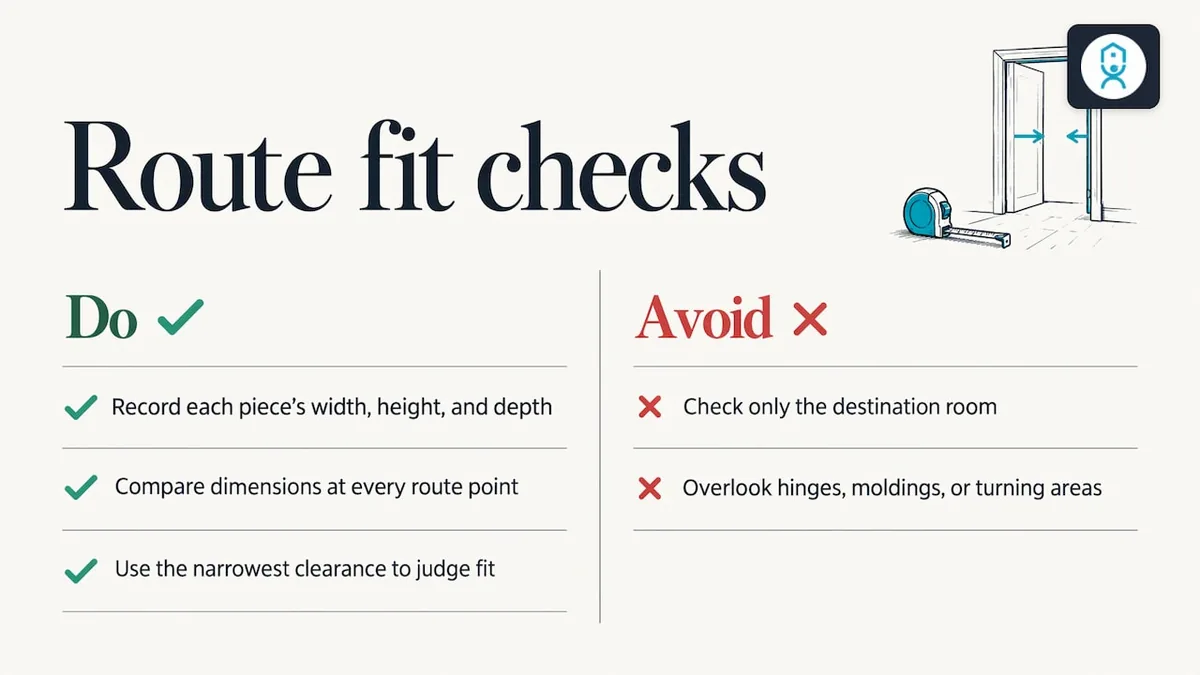
Measure the whole route
A piece has to fit through every point from the street to its final spot, not only the destination room. Designers advise that the narrowest or lowest clearance along the path decides whether delivery is possible, including door frames, hinges, moldings and turning areas. In a San Francisco flat, that usually means the front door, a narrow entry stair, a landing and a bedroom door. Write down the width, height and depth of each piece and compare them with each of those points.
Confirm building rules
Apartment and condo buildings in San Francisco often set their own delivery rules: approved hours, a reserved freight elevator, and sometimes proof of insurance from the crew. Ask your property manager or HOA what they require and give them the details early. Offices and medical or retail suites usually have similar requirements, and they are often stricter. If your building needs a certificate of insurance, ask for it when you request the estimate rather than the day before.
Plan the curb
On steep or crowded streets, where a large truck stops matters. In San Francisco, the city’s transportation agency, SFMTA, issues temporary no-parking permits to reserve curb space for moves, so check its current process if your street has limited parking. A reserved curb shortens every carry and lowers the chance of a ticket during the job. On the Peninsula and in Silicon Valley, many neighborhoods and complexes have their own rules about truck parking and delivery hours, so ask your HOA or property manager.
Clear the destination
Remove rugs you do not want moved, take items off the walls where a tall piece will go, and make sure the room is empty enough for the crew to work. Do not open boxes before the assembly crew arrives. Opened cartons can lead to lost hardware and misplaced parts.
When to hire a professional to assemble
A simple side table is a reasonable weekend job. Other pieces are not. Professional assembly is the smarter choice when the item is large or complex, or when it needs to be secured to a wall: bunk beds, tall wardrobes and modular systems can become safety hazards if built incorrectly. It also makes sense when you are short on time or cannot lift the parts safely.
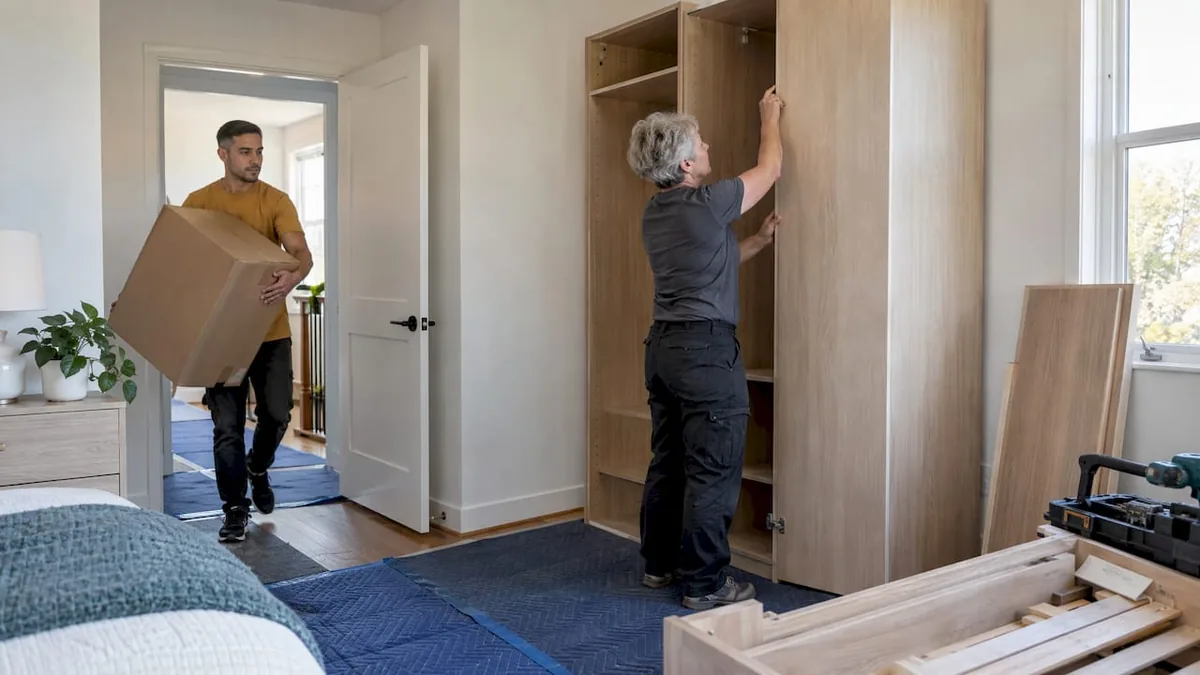
Wall anchoring is a safety point worth taking seriously. The U.S. Consumer Product Safety Commission recommends anchoring furniture, including dressers, securely to the wall to reduce tip-over injuries. If you have children in the home, make anchoring part of the assembly job for every dresser, bookcase and wardrobe.
Batching helps as well. If you have several pieces to build, schedule them together so the crew builds everything in one visit. Our furniture assembly and disassembly service works in the same way: we document what needs to come apart and go back together in the estimate.
Delivery day: inspect before you sign
Have someone at home who can approve placement. Then check the work while the crew is still there.
- Look at each piece top to bottom, including the back and underside, for scratches, dents and loose parts.
- Open drawers and doors, and test that they close evenly.
- Check that the furniture is level and that wall-anchored pieces are secured.
- Make sure packaging and debris are gone.
- Sign only after you are satisfied.
Consumer Reports advises inspecting furniture while the delivery team is still in your home and checking it before you sign the delivery certification form. It also notes that some stores set a short window for reporting damage, for example seven days at one retailer, so report problems quickly.

Compare delivery and assembly terms before you schedule
Compare providers on scope, not on price alone. Put these items side by side:
| What to compare | Why it matters |
|---|---|
| Placement | Room of choice or first dry area changes who carries the piece upstairs |
| Assembly | Bolting legs on is different from building and anchoring a full wardrobe |
| Packaging | Removal is included, extra, or left for you |
| Old furniture | Disposal is included, separate, or not offered |
| Timing | A scheduled window with advance notice versus an all-day range |
| Documentation | A written estimate with the scope spelled out |
Vague wording is the biggest risk. Legal analysis of white-glove contracts points out that a listing for “assembly” might cover only bolting legs onto a table rather than calibrating a motorized recliner, and that a vague scope of work tends to be read in the carrier’s favor. Everything you expect should be written into the estimate.
For a household move, also confirm the mover’s credentials. California requires a permit from the state’s Bureau of Household Goods and Carriers for moving household goods entirely within the state, and federal operating authority for moves between states. Impel Moving is licensed and insured under California permit Cal-T / MTR 0192323, and long-distance moves run under US DOT 3549568.
Old furniture, packaging and the rest of the move
New furniture often means old furniture has to go. If a sofa or bed frame is leaving, put it in the same plan as the delivery. Our furniture disposal service removes pieces you no longer want, so the same visit that brings in the new set can clear out the old one. If you are moving homes at the same time, unpacking and packing services can be added to the same estimate, and valuable items such as artwork are covered in our guide to moving art, antiques and valuables.
Office moves follow the same pattern with more pieces. Workstations, conference tables and storage units need to be disassembled, labeled and rebuilt in the right layout. We cover that in office relocation, and what to do with furniture you will not take along in our post on office furniture removal.
Perspective: why scope decides the outcome
Furniture delivery goes wrong in the same few places: unclear scope, a path nobody measured and a crew that was assembled for the day. We handle it differently. Our crews are Impel’s own uniformed, trained employees, never day labor, so the people who carry your furniture in are the people we trained to protect it.
We start with a documented scope and a written estimate, and one coordinator stays with you from quote to placement. That is what lets us put disassembly, reassembly, furniture protection and placement in writing rather than leaving them to be negotiated at the door. Standard residential moves already include furniture protection plus disassembly and reassembly.
In San Francisco, the Peninsula, Silicon Valley and Marin, our crews work these streets and buildings every day. Walk-ups, freight elevators and tight stairwells are part of how we plan a job, not a surprise. If you are bringing in new furniture, moving existing pieces or doing both, put everything in the scope and get it on paper before moving day.
Julia
How Impel Moving handles furniture delivery and assembly
If your move includes furniture that needs to be built, placed and protected, start with our white glove delivery and furniture assembly and disassembly services. They sit alongside our residential movers, apartment movers and large home movers, so a single coordinator can plan the whole job.

To see what your project involves, get a free written moving estimate from Impel Moving. List the pieces to be assembled, the floors and elevator or stair access at both ends, and any items you want removed, and the estimate will document the scope.
FAQ
How much does it cost to pay someone to assemble furniture?
It depends on the piece, the access and whether delivery or placement is included. Published retail white-glove fees typically run $60-$400, according to 2020 reporting. With Impel Moving, the final cost comes from a written estimate based on your documented scope, and local moves have a three-hour minimum.
Can furniture be delivered assembled?
Some pieces, such as sofas and upholstered chairs, usually can. Beds, wardrobes, bookcases and modular units generally arrive in parts. Measure the full route to the room before deciding, because a fully built piece that cannot make a stair turn will have to be built on site.
What does white-glove furniture delivery include?
It generally means delivery to the room of your choice, unpacking, assembly and packaging removal, but the term is not standardized. Confirm each of those items in writing. Our white glove service page explains how we handle it.
Do I need to be home during delivery and assembly?
Yes, or someone you trust should be. You or your representative should approve placement and inspect each piece before signing off, so any problems are raised while the crew is still there.
Sources
- Make Furniture Delivery and Returns as Hassle-Free as Possible - Consumer Reports
- How to Measure Furniture for Delivery - Z Gallerie
- CPSC Adopts Final Consumer Product Safety Standard to Prevent Tip-overs of Dressers - U.S. Consumer Product Safety Commission
- White Glove Delivery Contracts: Coverage, Liability, Fees - LegalClarity
- Household Movers Laws - California Bureau of Household Goods and Carriers