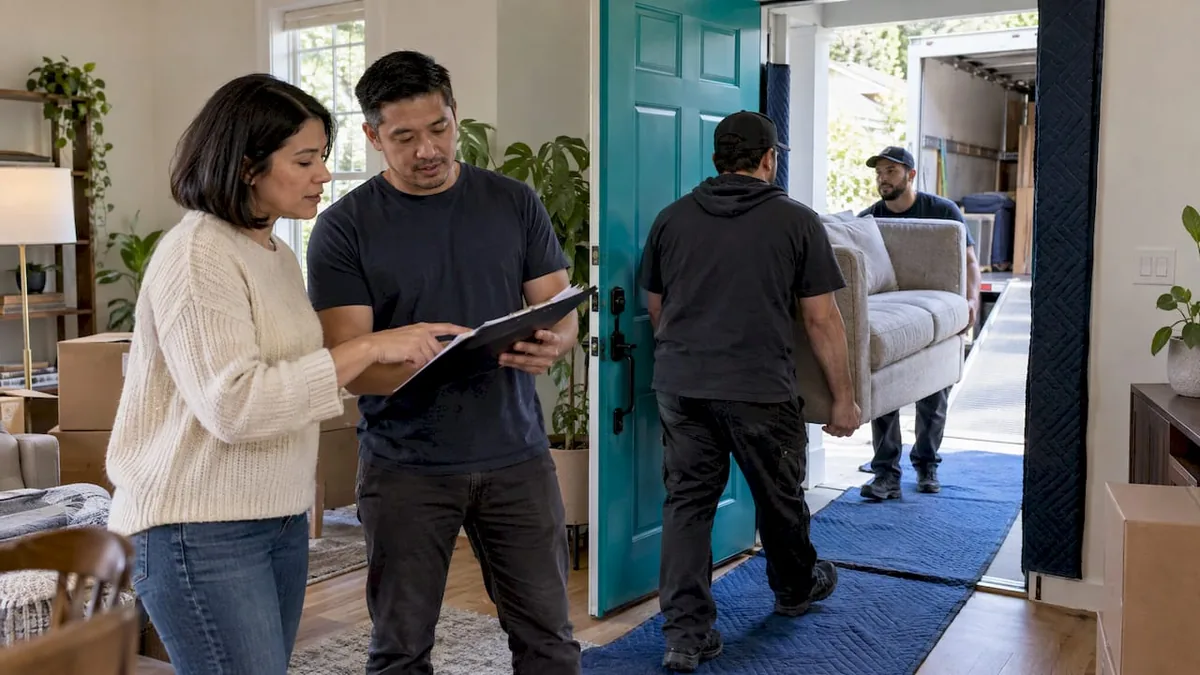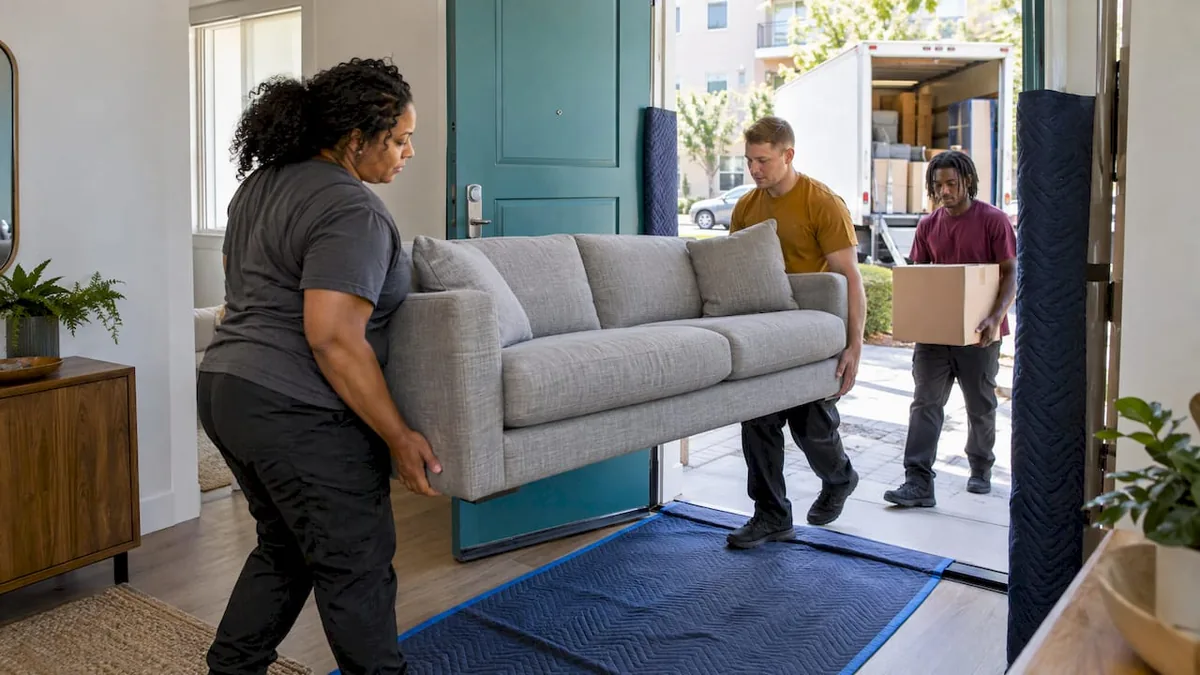

A licensed interstate mover is a company registered with the federal government and holding a U.S. DOT number. The Federal Motor Carrier Safety Administration (FMCSA) states this requirement for every mover that crosses state lines. You can check any company’s record yourself in a few minutes, before you hand over a deposit or an inventory. This guide shows how to check, what to look for in the estimate and contract, and where moves go wrong.
It is written for families, apartment renters and offices planning a move out of state. We are a Bay Area moving company, and we would rather you book anyone, including us, with the paperwork in front of you.
TL;DR
- Interstate movers must be registered with FMCSA and have a U.S. DOT number. Look the company up in FMCSA’s database before you request a quote.
- Brokers and carriers are different. A broker arranges the move, and a separate registered mover drives the truck and handles your things.
- Get written, signed estimates. FMCSA says not to accept verbal ones and not to sign blank documents.
- Choose your valuation (liability) coverage on purpose. The default for many moves limits payment to 60 cents per pound per article.
- Keep the bill of lading until delivery, payment and any claim are settled.
Table of Contents
- What “licensed” means for an interstate move
- Is your move actually interstate?
- How to verify a mover in five minutes
- Carrier or broker: who will actually show up?
- Reading the estimate
- The contract: bill of lading and inventory
- Valuation: how your belongings are covered
- Warning signs of an unlicensed mover
- If something goes wrong
- Moving out of the Bay Area: how we work
- Our perspective
- FAQ
- Sources
What “licensed” means for an interstate move
For a move between states, the license is federal. FMCSA, part of the U.S. Department of Transportation, requires interstate household goods movers to be registered with the federal government and to have a U.S. DOT number. A state business license or a city permit does not replace that.
Three things are worth knowing:
- The USDOT number identifies the company in federal records, including its safety and complaint information.
- Registration status tells you whether the company is currently allowed to operate.
- Insurance on file matters because FMCSA says interstate household goods movers and brokers must maintain the applicable insurance.
A company that gives only a state license number, or no number at all, for a move across state lines has not answered the question you asked.
Is your move actually interstate?
Most people assume interstate means two different states. FMCSA’s definition is broader: an interstate move is transportation between a state and a place outside that state, or between two places in the same state if the shipment travels through another state or a place outside the United States.
That matters if you are moving within one state but the truck route crosses another. It also matters to Californians heading to Nevada, Oregon or Arizona. If your goods cross a state line, plan on federal rules and a federally registered mover.
How to verify a mover in five minutes
Do this before you compare prices. A company that fails here does not belong on your shortlist.
- Get the company’s legal name and USDOT number. A legitimate mover gives both without fuss. Ask for the DBA (“doing business as”) name too, since the trade name on a truck often differs from the legal entity.
- Search FMCSA’s Search for a Registered Mover. The FMCSA tool shows registration status, business type, headquarters, contact information, complaint information and safety information.
- Cross-check the federal record. FMCSA’s Licensing & Insurance Carrier Search accepts a USDOT number, docket number, legal name, DBA name and state, so you can confirm the same company shows up under each.
- Match the details. The address, phone number and name in the database should match the quote, the website and the truck.
- Repeat for every entity involved. FMCSA says both movers and brokers must be registered, and each should be checked in its database.
If you are comparing Bay Area companies, our guide on how to check that a San Francisco mover is licensed walks through the same habit at the local level. Our licensing, insurance and COI page explains the credentials we carry and the certificate of insurance (COI) that buildings and offices often ask for.
Carrier or broker: who will actually show up?
Many online quote forms are run by brokers. A broker arranges transportation but does not operate the truck or handle the shipment. The moving company that does the work is a separate business, and you may not learn which one until close to moving day.
Brokers are legal, and FMCSA sets rules for them. According to the agency, a broker must:
- give you the Rights and Responsibilities booklet and the Ready to Move brochure,
- provide a list of the movers it uses,
- use only FMCSA-registered movers,
- keep written agreements with those movers, and
- identify its broker status in its advertising.
All of that is in FMCSA’s fraud FAQ. So ask one plain question early: “Will your own employees and trucks do my move, or will you hand it to another company?” Then verify whichever company answers.
This is also where the reader’s experience differs most. With a carrier that employs its own crews, one team can see the move from planning to the last box. That is our model: full-time, trained staff rather than subcontractors, and one dedicated team for each move.
Reading the estimate
The estimate is where most surprise bills are born. FMCSA’s rules on estimating charges give you a clear checklist.
What a proper estimate includes
- It is written, signed and dated.
- It lists transportation charges, accessorial charges (extras such as packing, stairs or long carries) and advance charges (services a third party performs for you, which the mover pays for first).
- If your home is within 50 miles of the mover’s or its agent’s business, the estimate must be based on a physical survey of your belongings, unless you waive that in a signed written agreement before loading.
Binding vs. non-binding
A binding estimate sets the charges for the quantities and services listed. A non-binding estimate is based on estimated weight and the services you requested, and it does not bind the mover to that figure.
For non-binding estimates, FMCSA’s 110 percent rule applies. A mover generally may require payment at delivery of no more than 110% of the non-binding estimate. Anything above that is billed later. A binding estimate is payable according to its written terms. Both rules are described on the FMCSA estimating charges page.
A worked example. Say a non-binding estimate comes in at $6,000. At delivery, the mover can generally require up to $6,600, which is 110% of that figure. If the final weight-based bill is $7,200, the remaining $600 is billed afterward, not demanded before your furniture comes off the truck. If you had a binding estimate for the same listed items and services, you would pay the written amount.
Two habits keep estimates honest:
- Never accept a verbal estimate. FMCSA says to avoid verbal estimates and not to sign blank documents.
- Compare several written estimates. FMCSA recommends comparing written estimates from several movers, checking complaint history and not choosing only on price.
If you want to see how a written quote is put together, our guide on how to read a moving quote breaks down the lines you will see.
The contract: bill of lading and inventory
The bill of lading is both your moving contract and the receipt for your shipment. FMCSA says the mover should give you a partially completed copy before leaving your origin residence.
A short routine protects you on loading day:
- Walk through with the crew while they inventory your goods.
- Read the completed documents before you sign anything.
- Keep your copy of the bill of lading until delivery, payment and any claims are resolved.
- At delivery, write any damage on the inventory before you sign the delivery papers.
That sequence comes from FMCSA’s Ready to Move brochure, which also says to be present during loading and delivery. If you cannot be there, send someone you trust who can sign for you.
Before the move, movers must also give interstate customers the Your Rights and Responsibilities When You Move booklet and the Ready to Move brochure, along with complaint-handling information and a contact telephone number. If neither has reached you by the time you are choosing a date, ask for them.
Valuation: how your belongings are covered
Moving “insurance” is a loose term. On interstate moves, the coverage you choose is called valuation, and FMCSA identifies two choices:
| Option | What it means |
|---|---|
| Full Value Protection | Replacement-value protection, subject to its terms |
| Released Value Protection | Liability limited to 60 cents per pound per article when you waive full value |
Here is what 60 cents per pound looks like. A 40-pound flat-screen TV would be covered for $24 under Released Value Protection, whatever it cost you. That is why we suggest you decide on valuation deliberately, in writing, rather than letting it be a box ticked in a rush. Read what each option covers and costs on your paperwork, and keep a list of your high-value items.
For art, antiques and other valuables, see our notes on moving art, antiques and valuables.
Warning signs of an unlicensed mover
FMCSA’s 2024 Protect Your Move campaign told consumers to plan ahead, verify registration and household goods authority, review contract terms and make sure documents are complete before signing. Here is how that looks in practice:
- No USDOT number, or a number that does not match the company name in FMCSA’s database.
- A quote by phone or email with no look at your belongings, when your home is within 50 miles of the mover’s business.
- Pressure to sign a blank or incomplete document.
- A broker that will not say which mover will do the work.
- A company name that changes between the quote, the contract and the truck.
- A price far below the others, with no written terms behind it.
One of these is a reason to pause and verify. Several together are a reason to walk away.
If something goes wrong
FMCSA receives complaints about interstate moves and may investigate a mover. Use it to report a company’s conduct.
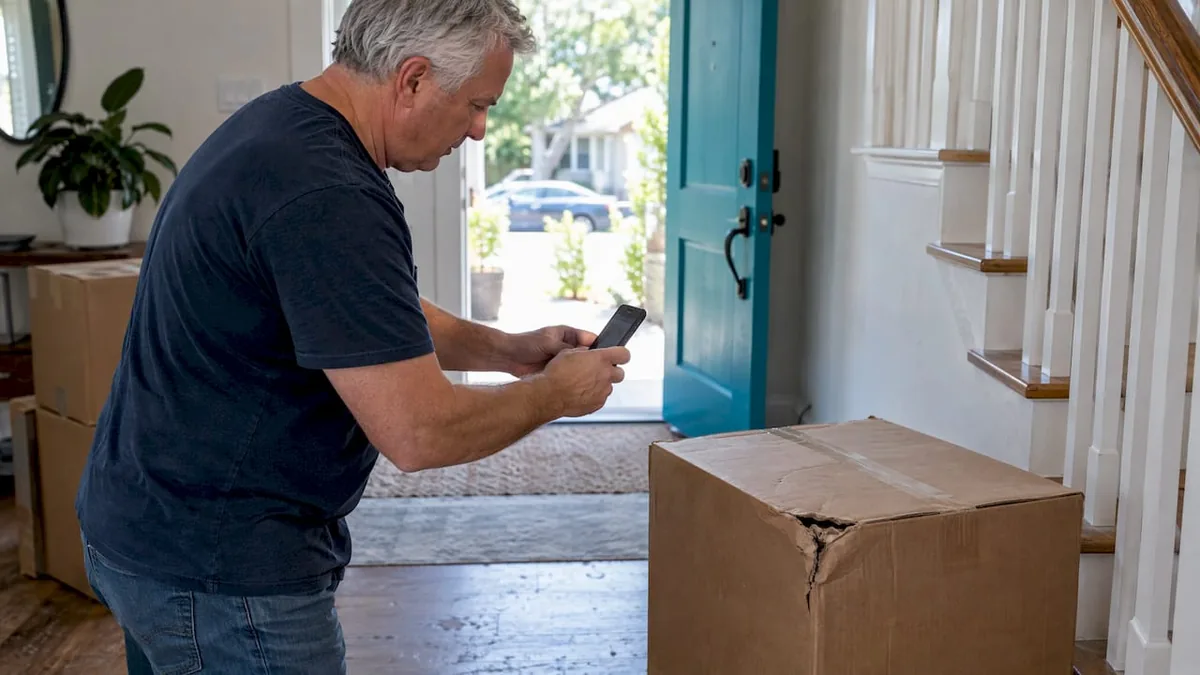
For lost or damaged goods, the claim goes to the mover. Wisconsin’s consumer protection agency notes in its interstate moving guidance that a written claim generally must be filed with the mover within nine months after delivery. It also explains that you pursue the claim directly with the mover or its dispute process, while FMCSA is the place for registration checks and complaints. Photograph damage when you notice it, note it on the inventory at delivery, and file in writing well inside that window.
Moving out of the Bay Area: how we work
If you are leaving the Bay Area, our long-distance moving service is built around the things this article keeps coming back to. We are a family-owned company. We employ full-time, trained staff rather than subcontractors, assign one dedicated team to each move, and give clear written quotes. We are licensed and insured, and we support you from planning through post-move follow-up.
Packing is where many long moves are won or lost, and we offer professional packing and unpacking, furniture assembly and disassembly, and support for specialty and high-value items. You can see our packing services and rates or ask for a free moving quote.
If the move is for an office, our commercial movers page covers office, corporate, retail, medical and dental, restaurant and warehouse relocations.
Our perspective
Most moving problems start before the truck arrives. They start when a customer picks a name from a quote form and learns later that the company on the phone is not the company on the truck.
We built Impel around a simpler idea. The people who plan your move should be the people who carry it out, and they should be our own full-time, trained employees. One dedicated team stays with your move from start to finish, so you are not explaining your floor plan, your fragile pieces or your timeline to a new crew each time.
The same goes for price. A quote should be in writing, with clear terms, so that you can compare it line by line with any other quote on your desk. We would rather you read it twice than sign it fast.
Verification is part of choosing well. Look up the USDOT number, ask who does the work, and read the contract. We are happy to be checked, and our licensing and insurance details are on our credentials page.
Julia
FAQ
Do all interstate movers need a USDOT number?
Yes. FMCSA says interstate movers must be registered with the federal government and have a U.S. DOT number. You can confirm a company’s registration and see its complaint and safety information in the FMCSA search tool.
Is a state moving license enough for a move to another state?
No. A move across state lines falls under federal rules, so the mover needs FMCSA registration and a USDOT number. A route that passes through another state can also make a move interstate, as FMCSA’s definition explains.
What is the difference between a mover and a broker?
A mover transports and handles your shipment. A broker only arranges the transportation and uses registered movers to do the work. FMCSA requires brokers to give you a list of the movers they use, so ask for it and verify each one.
How much can a mover charge at delivery on a non-binding estimate?
Generally no more than 110% of the non-binding estimate, under FMCSA’s 110 percent rule. Any amount above that is billed afterward. A binding estimate is payable according to its written terms.
How long do I have to file a damage claim?
A written claim generally must be filed with the mover within nine months after delivery, according to Wisconsin’s interstate moving guidance. Note any damage on the inventory at delivery and file in writing as soon as you can.
Sources
- Search for a Registered Mover, FMCSA
- Questions About How to Protect Yourself From Fraud, FMCSA
- Licensing & Insurance Carrier Search, FMCSA
- Tips for a Successful Move, FMCSA
- Estimating Charges (Subpart D), FMCSA
- Steps to Select a Mover, FMCSA
- Consumer Rights and Responsibilities, FMCSA
- Ready to Move brochure, FMCSA
- Protect Your Move campaign, FMCSA
- Background, FMCSA
- Interstate Moving, Wisconsin DATCP